The Awe of the Muscle Car (Chevrolet Camaro)

As a European, muscle cars are something that have often eluded me. Sure, I understood why people would buy them, but I had no idea why I should buy one. Driving one does feels like an occasion. Turn them on, and the old V8 growls awake. Then you have the straight-line performance, which is often pretty good. Cornering though is often an issue.

I always thought myself more of a Mustang man. Boss 302 for me, please. However, just like many Europeans, it would remain at the dream stage for me. Owning a muscle car in Europe is like owning a cheetah with a taste for human flesh, it just would not happen.

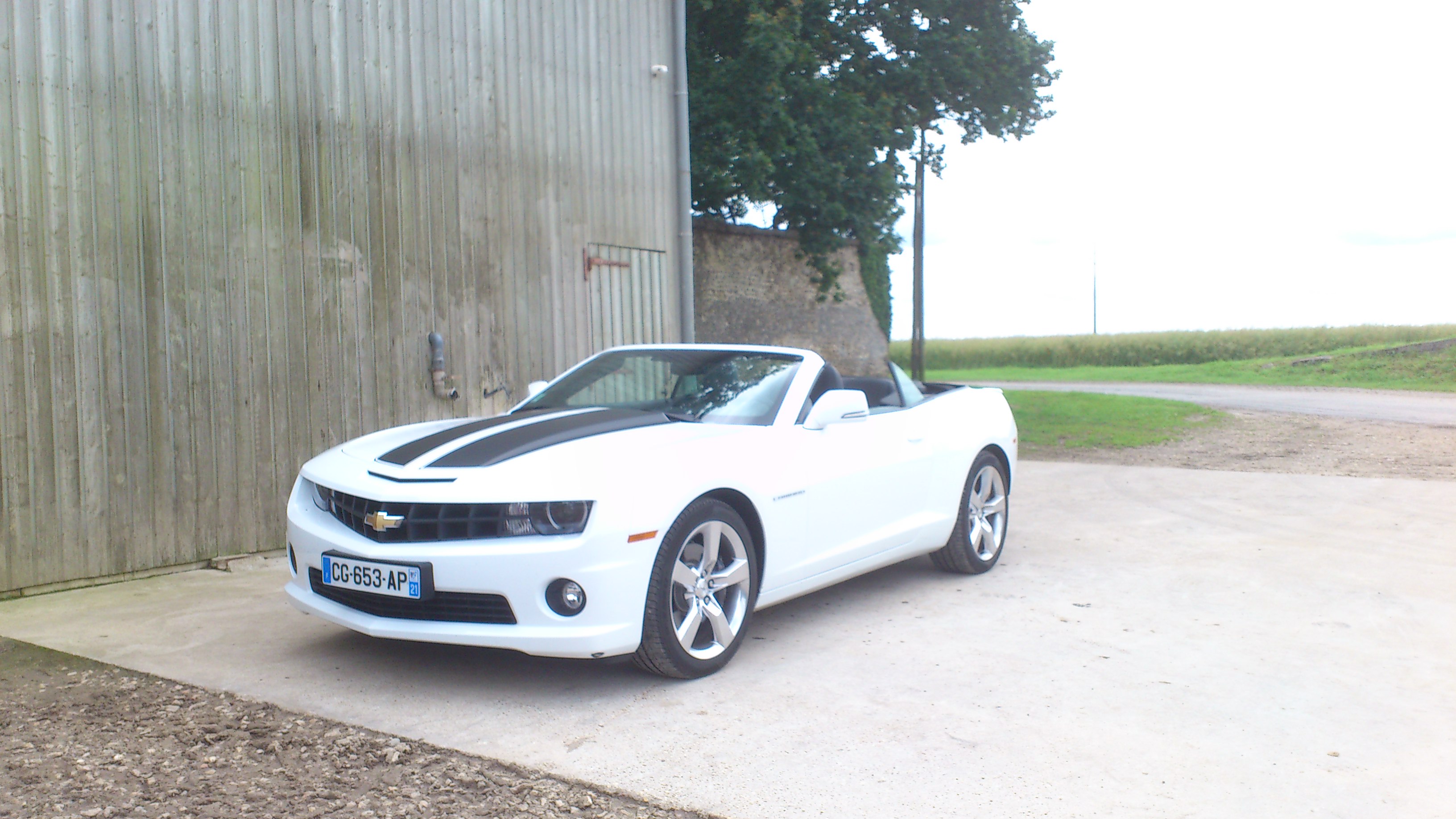
Then one day, I was invited to drive a European version of the 2012 Chevrolet Camaro Convertible. It was a white one with go-faster black stripes (retailing for a meager €1,200). Under the hood was a powerful 6.2L V8 doing about 420bhp. Seemed like a lot, until I remembered the Germans can get that power from a V6, and the Japanese from a 4-banger. The great point about this Camaro was that it had a manual gearbox. This way, you actually felt that you were in control, trying to wrestle with the huge engine.

From the outside, the whole thing was very American. The car was very wide, high, big, a pantomime of a car really. The wheels may have been 21 inches, they looked of average size on it. Outside, it is all sharp edges, making the car look cool and retro, but it does feel slightly over the top. Inside, the driver is greeted with cheap plastics and retro counters. It looked good, but did not feel right for the price tag. Once installed though, the driving position was very good. You had great overall vision (it is a convertible after all), and the seats were comfortable (it is American after all). Inside, it does feel fairly small, however, considering the size of the beast This is partly due to the big centre console, upon which sits the gear lever, and an awkwardly placed handbrake. Everything felt in its proper place. Turn the ignition on, and that familiar V8 growl greets you, albeit slightly muffled. Not as good as what Mercedes can do with a 6.2L V8 though.

Now this was my first time driving such a car, and I was a bit scared. Would the car spin hopelessly when I touched the accelerator pedal? Would I crash into my nearby parked Golf? Luckily none of these happened. The clutch was not hard to operate, and the car just moved forward, with no hassle. The gearbox may have been a bit stiff, but once you got used to it, it actually felt very good. On the open road though, I got an epiphany.

Mash the throttle, and the car howls with pleasure. It leaps forward, and you are greeted by the great sound. Your senses come alive and you get a small adrenaline rush. It may be a very wide car, but because of the good visibility, it is very easy to place on the road. I had no fear at all with on-coming traffic. The Camaro may be 1.92 meters wide, it was very easy to drive. Then came the bigger shock when I faced my first corner. I turned the wheel, and the car obeyed with no hesitation, the steering was precise and direct, perfectly weighted. It may not offer the driving feel of a Porsche 911, but it is still very good, considering what we knew about old muscle cars.  It did not feel like an American movie car, where you steer in a straight line. Here, you turn, and the car immediately reacts. Dare I say it? It handled like a European car! No hassle, no body roll, just simple precise movements. They even got the damping spot on, not too firm, but it allowed you to feel the road. Don’t get me wrong, it was no Elise, but for the size, it was very good. I would go on to say it was as good as the C63 AMG I drove. What a joy it was to fling these near two  tons of American muscle through windy European roads. I was in love.  And because you do not see this type of car everyday in Europe, people smile and wave at you. In this car you look like a fun guy with some imagination, in the equivalent Audi, you look like a pretentious douche.

The only slight disappointment I got was with the engine. I always imagined these old American V8s were torque monsters, which could burn rubber by simply looking at the gas pedal. With this one though, it felt a bit weak below 3,000rpm. After that, you felt the power, but below, it just lacked grunt. Mash your foot down at 2,000rpm and there would be some lag before the car decides to properly go. Thinking of it, it felt like a sporty European engine, where you have to rev it to get the best power. Could it be that this is actually a European car in disguise?

This being a muscle car also, what better way to unwind after all this excitement, than to disconnect the traction control and do a bit of hooning, via some good old fashioned elevenses. It was a little disappointment then, however, as when you mash your foot down, and lift off the clutch, the ensuring burnout was relatively small. More sound, power and torque was needed methinks, and I can only hope to drive the new LS1 version then.

This drive has converted me. That combination of European handling and American muscle is perfectly balanced, it is weird the Mustang is not like that, given Ford’s European links. Screw the Mustang, my muscle car of choice is now the Camaro, in convertible form, to enjoy that glorious sound.  Unless I get my hands on a Cadillac CTS-V.

The only problem I could see with owning a Camaro in Europe is the fuel consumption. After a day of hooning, I managed 10 miles per gallon, which is very, very expensive in the long run.

However, given the amount of fun you can have, and the smiles you get, it is worth it. And taken into account the price per horsepower, it is actually a great bargain!

Posted in Car reviews | Tagged , , , , , , , , | 5 Comments

Has the Tata Nano killed the city?

When it came out three years ago, environmentalists were in uproar. How could Tata dare to build such a cheap car, accessible to everyone? Since everyone could buy one, they argued, cities would be congested to breaking point, and we would not be able to move around anymore. Moreover, because of its emissions, the Nano would have singlehandedly killed every single Indian alive.

Well, three years on, I was in India, and guess what ? Things are exactly as they were. Yes, you do see the Nano quite a bit, but it is not in every single parking space, and the traffic certainly does not consist of an endless line of little tall cars.

Talking to a few friends, I think I got to the bottom of why this is not the case.

First of all, just like Dacia in France, the Nano does not have a good reputation. Marketing your car as affordable to the poorest people instantly makes it unattractive to the more well-off people. Drive a Nano in India, and people may think you are of a very low income. And in an increasingly trendy image conscious society, what you drive is vital into saying who you are. As a result, if people can afford a car, they will go for the bigger Indica, as the Nano is a car for “poor” people.

Secondly, the Nano is too cheap. Believe it or not, but there is such a thing as a product being too cheap. Because of the unbelievably low price, there is a fear in people’s minds, that the Nano is a sub-standard product. Many people wonder how Tata can produce such a cheap car, it cannot be possible. The biggest fear is that they have saved on safety, therefore, a lot of people call the Nano an unsafe car. Tata may spend millions on marketing, proving that the car is safer than the equivalent competitor, it would never change. It is also now too late for Tata to raise the price now, as people have already seen how cheap the car is. Raise it now, and they will only cause more skepticism.

Thirdly, the Nano aimed for the wrong market. Ratan Tata famously said he wanted to give an alternative to the scooter carrying families, therefore it was designed to be the same price as a scooter. At that level, it was a success. However, owning a car and a scooter are two very different concepts. Owning a scooter in India is easy. You do not have to worry about parking, moving along the city is easy, and maintenance is a breeze. With a car, it is a completely different thing. Parking is a big issue in the city. If you can park your scooter, chances are you will not be able to do the same for your car. Driving in the city is also very difficult. The congestion can be very bad, sometimes it may even take three times as long to do a journey by car, than by scooter. Finally, maintenance is more demanding on the car, whereas the scooter can pretty much be forgotten.

That said, the Nano is not a complete failure. For one thing I like it. I think it looks funky and cute. Moreover, owning a small city car that you can have fun with, without having to worry about expensive maintenance or repair bills is always a good thing. After that, people are buying Nanos. Yes, the middle class in India is huge, and the first car they buy is usually a Polo or a Civic. However, the people who are less well off still need some form of transport. And compared to the scooter, the Nano does offer one commodity that scooter drivers can only dream of : shelter. When it rains in India, trust me, you do not want to be on a scooter ! In the end, the Nano is not really replacing the scooter. What it is doing, is replacing the old Maruti 800 and Fiat Padminis. It is already replacing a car, and an aging uneconomical one at that. So on that level, it may have a positive environmental impact.

Don’t get me wrong, I do not think the Nano is a bad car, in fact, I am desperate to drive one. As a matter of fact, if I were to live here, it would most certainly be my car of choice at the beginning. After all, it does have one feature that no price can be put on in 40° heat : an aircon.

Posted in News | Leave a comment

So what does the future look like?

I have been very busy lately, mostly working on my university dissertation. As a car fan, I chose to do it on how Green Consumerism can affect our automotive choices. I will not bore you with the details of this 10,000 word project, but at the end of the day, I found something interesting.

People are interested in the environment, and do take it into account when buying a car. However, they are not prepared to pay a massive premium for an electric car, and electric cars are still not viewed in a favourable light. That is why, of the electric car dealers I spoke with, all their vehicles were sold to companies or city councils, looking for tax-breaks or to meet with emission targets. The car as we know it will be here to stay for quite some time.

The fact is this: When choosing a new car, people will look at emissions and fuel consumption, and will take these characteristics into account when choosing their car. However, they will not sacrifice their mobility and freedom for the environment. That is the problem with the battery-electric car, while it is a good concept, it is still as useful as a tin of beans – good, but limited-. I still believe they are not the answer, more of an intermediate step. In town, they make perfect sense (providing you have a charging station available). But to those who live out of the town, they are useless.

Think about what the car gave us: Freedom and mobility. If I wanted to, just this minute I could drive down to Turkey, in three days. That is because fuel is available everywhere, and it only takes a few minutes to fill up. In an electric car, the journey would be more of a headache, as I would have to plan overnight stops every 80 miles and make sure there was a good place to charge, and take about a month to complete.

Don’t get me wrong, I like electric cars; they are fun to drive, in the same way a golf cart is fun to drive. However they belong in cities. This does cause another problem, as the main problem in cities is congestion. If everyone gets an electric car, and has to park it overnight to charge, what good will that do to the infrastructure. Sure, the air quality might improve, but it would take 5 hours to do 5 miles. So in the end, no real solution there.

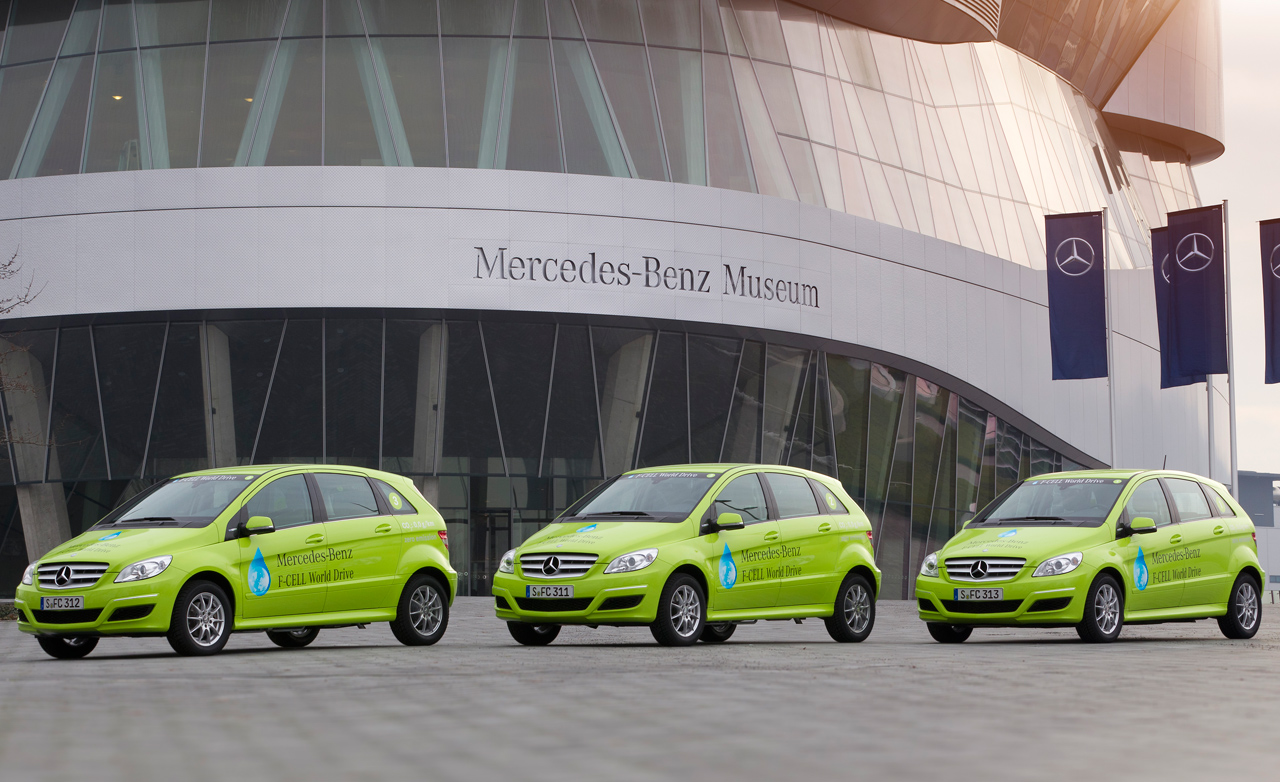
This leads me on to the Mercedes-Benz F-cell. They just proved how reliable the technology is, by taking a fleet of cars around the world. People liked to think they would cause another big hole in Ukraine, but bar one small collision, everything worked fine. This means the technology is ready, and safe. After all, hydrogen has come a long way, 15 years ago, the technology had to fit in a big van, now it fits in a B-Class. The only issue is getting the infrastructure in place. Shell is working on that, and I have no doubt that within 10 years we may see a viable one in place. The last issue will be cost. That is the same problem faced by battery-electric cars. At the moment, a very small electric car costs the same as a medium sized saloon. A similar sized hydrogen car costs the same as a Ferrari F12.

However, this is the same with any new technology, as any university scholar will know, thanks to Moore’s Innovation Adoption Lifecycle. The early technology adopters will have to pay the premium, so sales can begin, and then thanks to economy of scale, prices will go down. If I had the money, I would get a hydrogen car. Battery-power has existed for over a century, and has never really improved. A Nissan Leaf is just an incremental innovation, a Mercedes-Benz F-Cell is a radical one. In the long run, the radical innovation will be more utilised.

This is where marketing comes in. We love to lament about their rubbish choices, such as the diesel Renault Twingo Gordini. However, at the end of the day, they are the ones we trust with communicating a new idea to us. This has emerged in my dissertation research, as at the moment people do not know much about future technology. Hybrid has been done and understood. Battery-power is beginning to be understood, and creeps in to reviews around the globe. The next step should be Hydrogen. Once people understand it, they may embrace it.

I mean, a hydrogen car is just as dangerous as a petrol car (to a certain extent), is used in exactly in the same way, and is much less polluting. Green is the new black, so if you have the money, do not buy a Lamborghini Urus or a Tesla Roadster. Think of the future, do a choice that can make a change, get a Mercedes-Benz F-Cell when it come out. Or a Honda FCX Clarity. Or any hydrogen car.

Think about it: Walk – Horse – Petrol Car – Hydrogen Car – Teleportation.
Looks cool right?

Posted in News | Tagged , , , , , | Leave a comment

So, are supercars dead?

Only a couple of years ago, in his review of the Aston Martin V12 Vantage, Jeremy Clarkson lamented the fact that this was probably the very last V12 supercar, that later cars would all be turbo charged, and emit as much carbon dioxide as a mouse.

Fast forward a year, and we have the Lamborghini Aventador, with its 700bhp 6.5L V12, the Ferrari F12 Berlinetta, with its 740bhp V12, or even the Aston Marton One-77, with its 7.3L 750bhp V12.

Though the Bentley Continental GT just got a twin-turbo V8. As a result it is a better car, go figure….

The truth is, even though they are viewed as environmental anti-christs, these super powerful cars are useful for everyday cars. How? Let me explain:

-Technology: Just like Formula 1, these cars are technological masterpieces. To get that much power from the engine requires skill, and a focus on squeezing every last morsel of horsepower from each drop of petrol. This technology is unheard of, then gets expensive, then trickles down to your everyday car. As a result, your 100bhp 1.0L hatchback has a lot to owe to a Ferrari F50 for example. Exotic manufacturers try to get as much horsepower from an engine. What do mainstream manufacturers do now? Get as much horsepower from an engine. In both cases, the goal is maximum efficiency.

-Building the passion: It may not be very obvious, but building car awareness is important, and has been on the rise in recent years. Look at the fall of American car-makers in the late 2000s. People are working out that the car is not just a washing machine. More goes into that. The car is still a status symbol, why do you think all executives drive BMWs?
This knowledge can only be built through interest. And interest is built through passion. Without supercars, people will no longer be interested in cars. If the latest Ferrari had a 1.6L turbo engine, no one would take interest. As result, there would be no knowledge about cars, and as consumers, we would suffer. The experience would not be the same, and the quality would fall. That is why Chinese auto-makers must learn to spark passion and interest in their cars, otherwise they will not sell. Simply look at what Hyundai achieved with the Genesis V8.
One way to gain interest is to impress, and how do you do that? Think Big. Big numbers, as juvenile as this may sound, attract. If you don’t believe me, look at the Ipad 3, all the noise is made about the extremely high screen resolution. The more over-the-top the car, the more it will be loved. Don’t believe me? Look at the way the Lamborghini Aventador, the Pagani Zonda or the Ferrari F12 Berlinetta are described in car reviews.

-The craftsmanship: Just like the watch-industry, there are two sides to the car-industry. On the one hand, you have the Casios and Timex (the VWs, the Nissans, the Chevrolets), then you have the Swatchs and Festinas (BMW, Mercedes-Benz, Lexus), and then, you have the high end models, like Rolex or Patek-Philippe (Rolls Royce, Ferrari, Aston-Martin. You are not just buying a watch; you are buying a brand, a quality, and an aspiration to be the best. Ferraris are like that, there is the heritage, the quality, and the constant pursuit of building the fastest car. If a Rolex had a Quartz mechanism, would anyone buy-it? Same thing goes with A Ferrari and a V12.

I may sound like a passionate petrol-head, but every industry needs an over the top range. Yes, few people will buy it, but simply knowing they are there helps make the world an interesting place to live. And as long as we are still human, there will be V12s.

Posted in News | Tagged , , , , , | Leave a comment

Driving at night: Therapy or folly?

It is 2am and I can’t sleep.

Now a normal sane person would either persevere and try and sleep, or go on Facebook or Youtube to pass the time a bit. Given how awake I am, I reckon I will be awake for another two to three hours. I am also not a normal person.
So I get up, dress and go out. Each time I go out, I am usually greeted with the same Germanic face, my car.

You see where this is going….

I get in, turn my car on (and wake up the neighbours in the process), engage first and just drive.

When I just go for a drive at night, I never plan out where I am going. Will I go left or right? Will I go into town or in the country-side?

That is the first great thing with driving at night, there are no limits. Going into town does not mean having to sit in traffic all the time, the city is empty, everyone is asleep. Driving in the country-side means being immersed in total darkness and silence. It is scary and impressive at the same time. No tractors or lorries here, just you and nature.

When people drive at night in the country-side however, it becomes less about relaxing. When in the country, it becomes all about the communication between man and machine.
Driving fast during the day is, let’s be honest, stupid. There are so many users on the road that it makes every single car a potential accident. At night, you remove that parameter. You are now alone, in the dark.

The best thing to do is, like me; get a car with not very powerful headlights. That way you have a natural barrier that limits your speed. Trust me, when you can only see fifty metres in front of you, you do not want to drive fast!

However, you still do get to enjoy the ride! During the day, you listen to the radio, talk to you passengers, or wonder about another problem. At night, you have none of these (if you turn off the radio that is!). You communicate with the car feel its limits, what it’s telling you. Now is the time when you search for that perfect shift, that optimum line in that corner, or the best oil temperature at which to really push it. At night, everyone feels like a racing driver. Because of that limited visibility, it is at night that you feel more alive. Your body is conscious about the looming dangers ahead you cannot see, and because it is scared, the adrenaline pumps in.

Sadly, that is why there are so many accidents at that time. Because of the limited visibility, some bright people think its good time to try and go faster, even though they cannot see anything. You have to know you and your car’s limits.

That’s the typical view people tend to have about night driving, a crazy loner speeding through the country, soon to be featured on the front page of the local paper, in the big steel carcass his car once was.

In the city however, it is a totally different story. When you go for a drive at night, you are alone with no pressure or things to do. You simply do what you want to do, go where you want to go. It is one of those rare times where you feel you have time and freedom. This is more so the case when driving in town at night. It is a big paradox really; one pictures cities as places where everything moves fast, nothing stops. Yet at night everything does stop. When the last party-goer is in bed, silence creeps in. The city is now yours.

In my mind, cities look their best at night. That is the time where you get to truly appreciate their inner beauty. The lighting schemes are usually very cool, giving the city a new depth. It is no longer black on white, but white on black, which is very soothing on the eye and somehow enhances your other senses. Think about the night scenes in the movie, “Drive” with Ryan Gosling. The lone driver, in his car, at night. Cool wasn’t it? It may have been dark (the movie), but violence aside, the city became part of the movie, not just a simple background.
Moreover, the streets may still be lit, but that feeling of being alone in such a big place is a relaxing one. The fact that you are in your car further enhances that feeling. You are in your own metal shell, like a crab (as famously put by Jeremy Clarkson). You are no longer burdened with work or deadlines. You can now spend your time. You can think, reflect or plan.

It has been claimed that meditation can be achieved by focusing on a single task for a period of time, in silence, so the rest of the mind can relax.
When you drive at night in the city, this is exactly what you do. One is looking to find inner peace.

So there you go then, driving at night, not only can you feel truly alive, but it can also help you relax. And in today’s fast paced world, that is one folly we could all use.

Posted in Philosophy of driving | Tagged , , , , , , , | 5 Comments