Newsflash: The return of driving pleasure? The Alpine is back!

With the new Toyota GT86, Toyota and Subaru did something we all wanted a manufacturer to do: Bring back excitement in new cars. As I have said already, new cars are now increasingly boring, and to really get some spark in today’s performance cars, you need to go at three times the speed of sound.

With the GT86/BRZ though, Toyota publicly said “You know what, what ever happened to fun?” The result was a small light, rear-wheel drive coupe, with not a lot of power and a very lively rear end. People who complained it was underpowered and lacked grip completely missed the point. The idea was not to break lap times, but to make you smile. We all applauded saying driving pleasure was back.

However, since then, nothing really new has been announced. Today, this changed. An announcement was made that could, potentially, bring another player to the match. Curiously enough, it comes from France’s history.

You see, in 1955, a very atypical Frenchman, Jean Rédélé decided that what France needed, was a small affordable sportscar that would bring a smile to people’s faces. Here was a man who saw that the endless sea of 2CV and Peugeot 203 was not very exciting, and probably influenced the suicide rate at the time. What resulted was the creation of an iconic brand and car: The Alpine.

What the Alpine was, was the base of an everyday car, a Renault 4CV, and Rédélé changed it in order to turn it into a small sports car. The same thing Ferdinand Porsche did with the Beetle in a way, to create the 356. What Rédélé did, created history in the French auto industry. The following cars, such as the A110 were so emblematic, you even find them being collected in California. However, like all good things, after time, and with increasing Renault influence, the Alpine became bigger, more powerful and less attractive. This culminated with the A610, then died, in 1991.

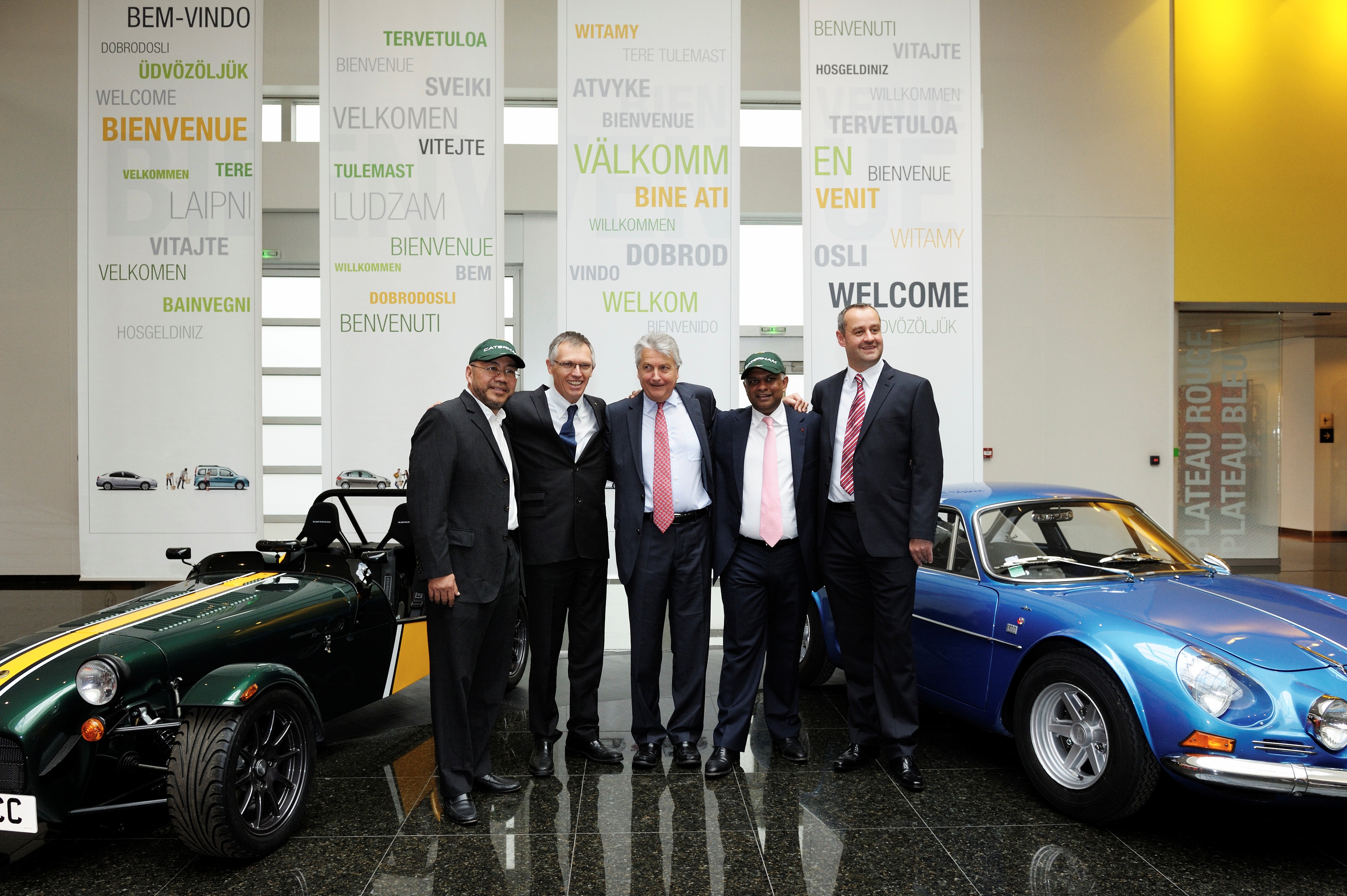
Today, though, Renault just announced what we all knew: Alpine is coming back. The fear in most enthusiasts’ minds was that it would be a heresy, like the Gordini revival as a ‘premium’ brand. To prove their commitment, Renault looked for a completely unlikely partner: Caterham. This is good news.

You see, Caterham specialises in keeping the Colin Chapman idea of “light is right” alive through the over-bloated sea of cars today. Caterhams are known for being one of the most fun cars do drive around, often ending up as track cars. This does cast doubts though, as the closest thing they have to a production car is the Caterham 7, which sells in limited numbers. You see, Renault plan to make between 5,000 and 10,000 cars a year. Yes, production will be mostly in France, but will Caterham be able to keep up with the distribution, service and experience? Let’s hope so! Caterham and Renault will each split ownership of the new Alpine company, splitting profits as well. The Alpine will be sold either as a Caterham, or a Renault.

The tie up with Caterham is a good thing also, as it means the focus will be on driving pleasure rather than all out performance. If there ever was a way to say this would not be a ‘Gordini’, this is the way to say it. France and luxury cars are hard to go together at the moment, so why not try something else? The success of the GT86/BRZ shows that enthusiasts want something different and fun in their lives!
Renault are talking about a maximum weight of 1.3 tons with 200-250bhp. This is also good. What is not so good is the choice of engine, as the 1.6 litre turbo 4 cylinder from the Nissan Juke (and soon to come out Clio RS) is rumoured to power the car. Not the most exciting engine I must say, then again the A110 had a 4CV engine, so they are keeping the spirit alive! As with the GT86, the focus is not the engine, but the fun. The choice of Renault’s EDC semi-automatic gearbox is curious though, as any purist would want a manual. I’ll just be optimistic and say that will be an option. Finally, the price, at 35,000-40,000€ is actually pretty good. Yes it may sound expensive, but considering the limited production numbers and the fun promised, it could be bang on the money. (Insiders at Renault think it may even be too low, so expect more expensive and premium models to follow, in order to make higher margins)

Oh, and it will be rear-wheel drive, with a mid mounted engine, and the press release talks about cars, so there could be more than one!.

Good on Renault!

Posted in News | Tagged , , , , , , , , | 3 Comments

France and the luxury car

Think France, and often visions of luxury follow. Not only stuff like the Chateau de Versailles, Louis the 14th, Paris or Champagne, but also products like high end watches, fashion, expensive wines and food, luxury hotels and the French Riviera. For a lot of things, being French gives an image of class, luxury and aristocracy. Look at Louis Vuitton, Moët Champagne, Cognac, Hermès or Michelin stars.

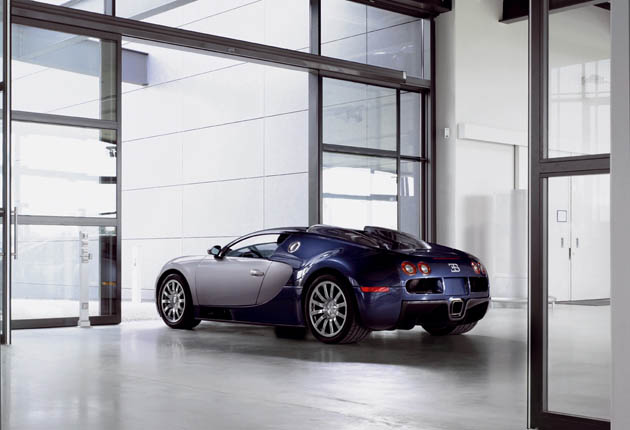
Yet today, when you look at the French car industry, it is year upon year of promises and attempts to go into the luxury segment, but it always ends in pretty shocking failures. (Let’s just disregard Bugatti, as much as I would like to say it is French, it is still mostly done by Volkswagen).

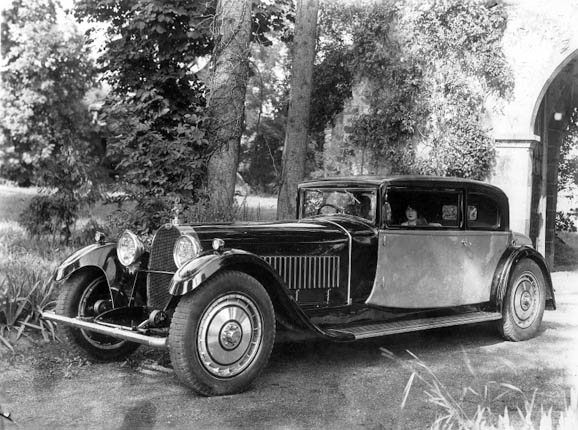
France has one of the greatest automotive histories in the world. After all, they invented the automobile, in 1769 with Nicolas Cugnot. Yes, it may have been steam-powered, and it may have crashed a couple of times, but the fact is, it was the first auto-mobile. Come the late 19th century, early 20th, French car manufacturers were all over the place. The usual players were there, Peugeot, Citroՙën and Renault, but also more exotic material, like Bugatti, Delahaye, DeDion-Bouton, Panhard, Delage or even Hispano-Suiza. Remember those names? If you do, what cars do you imagine they were? Yes, that’s right, it is mostly expensive luxurious vehicles, the type you would imagine only the finest and richest aristocrats would buy. Not sure about this? Look at this clip from Jay Leno’s Garage and a 1938 Hispano Suiza.

Fast forward a hundred years, and what do we have? The Dacia Logan (it is French, designed and engineered in Guyancourt, outside Paris).

So what happened? After all, France has all it needs for a luxury car brand: the image, the history and the craftsmanship.

A few things happened in fact. For one, the Great Depression. That wiped out a lot of those eccentric car manufacturers, who would make vehicles out of ivory and peasants’ skin. Then there was the Second World War. What ensued there shattered any hopes of having a luxury car lineage. When France was rebuilding, the government took control of a lot of things. One of those was the car industry.

Now, during the famous “Trente Glorieuses”, the idea was not of opulence, but of making the working man happy. What the working man needed was a simple car, not a car made of pure gold. So the government took all the manufacturers in France, or what was left of them, merged them into groups, and ordered them to motorize France. This was known as the “Pons Plan”. The idea was to structure the industry. Citroën got told to do luxury, and Peugeot and Renault the middle range. There was also Simca and Panhard who had to do the lower end vehicles. The government also introduced new taxes and fiscal measures that pretty much killed off the more expensive vehicles. So whereas brands like Delahaye or Bugatti got killed off, we got cars like the 2CV and the Peugeot 203. Oh the excitement!

The result of all this? The idea the world has of a pure French car is the Citroën 2CV, and something like the Bugatti Type 57 is completely forgotten. Talk about government involvement being uncool. It is almost no surprise that today, one of the most successful French cars is a low-cost one.

The next fifty years meant that with these fiscal measures, there was no reason for French manufacturers to make luxury cars. Yes cars like the Citroën SM managed to come out, but they were plagued with things like rubbish build quality, bad timing or other problems, that they were never such a big success.

Because of this focus on trying to build small cheap cars, we lost our know-how and image. The British kept on with Bentley and Rolls-Royce and look where they are today! Because of the government trying to control everything, we got all these small cars to please the common man, but when it comes to bringing up the image of a country, we have nothing. As a result, when we try to go against the Germans in the luxury car segment, it is always botched up jobs like the Peugeot 607.

To make a luxury car, you need four things: Image, Performance, Quality and Design. Lately, the closest thing the French companies had to this was the Citroen C6. Unfortunately, due to iffy quality and lack of proper engines and performance, it was a failure. Pity, it was one of the prettiest cars ever…

The biggest problem though, is the lack of image. After fifty years of making small affordable cars, French manufacturers just expect to be able to make a luxury car that will sell. However, this segment is entirely dependent on image, or history, and you cannot expect to just simply change people’s idea of French cars like that. Want proof? For a lot of people, the Bugatti Veyron is a German car, despite it being French in the end. Sad, but true…

Posted in Auto Industry | Tagged , , , , , , , , , , , | 2 Comments

Sergio Marchionne, or how not to lead a car company

Okay, so this article might be one big huge rant, but I seriously have to let out some steam. As I wrote earlier, one of the problems in the French auto industry has to do with leadership. Let me add to that:
One of the biggest problems in the automotive industry is Sergio Marchionne.

Here is one person, who seems to be single-handily destroying an entire group. Let me explain.

Mr Marchionne was appointed CEO of Fiat S.p.A in 2004. Fiat was not in the best of shapes back then. Yes, it did have an international strategy, but it seemed to have various levels of focus, and its world wide reputation was not the best. It was known for making cheap small cars that were not so reliable after all.
For a while, things were going along as they were, nothing much was changing. Alfa was still slowly dying off, Lancia was almost dead and Fiat was surviving. Marchionne stepped in, and started making things even more worse. Let me just take you through each brand, showing you how he is slowly killing each brand:

Fiat: Here is a great company, which had a great competency: it was one of the best at building basic cheap cars for the masses. Over the years, things were not looking so bright. Yes, the 500 was a success, as was the Panda. But the rest of its models? The Punto was still the same since 2005, the Bravo was a big useless lump of a car, and anything bigger had disappeared. What Fiat needed was a big investment in R&D to bring out new models, but what did Marchionne do? He bought Chrysler in 2009! And what did he do with Chrysler? He brought some of them in the Fiat range and tried to sell them as new cars. I mean seriously, the Freemont?
But that is not all! What new Fiats are coming out? Oh, another 500, only bigger, and another 500, only a crossover. He is milking his best cash-cow, the 500, aiming to go after fashion-related purchases. After all, it seems to work for Mini, right? The only problem is, on the one hand, Mini has a much bigger brand value than the 500, and on the other, Mini is a brand in itself. Marchionne seems to forget that Fiat is more than just the 500. Trying to replace the Fiat model range by only variations of a single car is not a good idea. What Fiat needs is to make new models, follow its core-competency, after all, Fiat is more than the 500. The Punto saved Fiat from near death and must be updated. But Marchionne is too focused on the short term, and just looking for the easy way out, by continuously cross-branding and adapting the same car. No surprise they are losing so much money to the point that Chrysler – a company almost dead 3 years ago- is saving them. Why is Chrysler doing well? Simply because they are actively bringing out new models and updating their old range. Why not do the same thing for Fiat?

Lancia: Here is a company with great heritage. Top Gear even called it the greatest automotive brand ever. Unfortunately, in recent times, it was not doing so well. The new Delta was anything but a homage to the original (I still cry inside when I see one in the street, partly due to its pointlessness, partly due to the heresy it is.), the Yspilon was not really selling either, and the Thema was gone. Marchionne’s answer: Use Chrysler. He saw the American company as a great opportunity to re-launch Lancia. Chryslers would be sold as Lancias in Europe and Lancias could be sold as Chryslers in the UK. So the Delta was sold as a Chrysler in the UK, and the 300 and Sebring were sold as a Lancias in Europe for example. Perfect no? Apart from the fact that, in today’s world, you just cannot do brand swapping anymore. If you take an American car that does not sell well in Europe, like the 300, and put a Lancia badge on it, it is not going to sell more. Cross-branding is part of what almost killed General Motors for goodness sake! What Lancia needed was new cars, not old ones! Lancia has everything for a premium brand, but you need to invest money to have the car that follows the premium image! Saying a car is premium does not help, look at Peugeot. But Marchionne did not understand this. He thought Lancia’s problem was the number of cars it offered, so he just stuck badges here and there, and hey presto, you have five cars! Moreover, bastardizing history, like the Delta, is just plain wrong.
The result? Lancia sales are at an all time low, so Marchionne, in all his wisdom said he would reduce Lancia to one genuine product, with the rest being rebadged Chryslers. In summary: The R&D budget is 0. In other words, he just engraved Lancia’s tombstone….

Alfa-Romeo: This one drives me furious. Here is a company with one of the greatest heritages of any car manufacturer. It has everything to be a luxury brand. It was failing, as always with manufacturers from the Fiat group, because of a lack of new models. So, we get the Mito and Guilietta, supposed to bring us back to Alfas of great. What they actually are, are a rebranded Fiat and a Delta. Alfas are supposed to be cars built around passion and great engines. What do we get? A fashion accessory and a Delta. How?
But then Marchionne says, look, we have the 8C, and then the 4C, cars that rekindle the Alfa spirit. Yes, the 8C is a great car, but what about for real people? The 4C then (if it ever comes out)? Here is a car, with the 1750 TBI engine (which is really bad) and which will be overpriced (since it uses carbon fibre and aluminium). And that is supposed to spearhead the rebirth of Alfa Romeo in the USA, a country famous for simple powerful engines and cheap, accessible performance cars. Oh, and big cars also, usually twice the size of the 4C.
To make matters worse, Alfa used to make one of the best engines in the world, the Arese V6. Its sound could be likened to Mozart, being played through speakers made of honey. But it got killed off, for emissions reasons we are told, and we got the 1750 TBI instead. Marchionne wants Alfa to be a luxury brand, but as I keep saying (particularly to French manufacturers), luxury brands need good engines. Not just for sales, but also for image. If the Guilietta had that V6, you know what, I would look at it. The Brera, which looked like God, had a V6, true, but from Chrysler. I wanted to adore that car, but that just killed it. The fact that it also did not handle well and was podgier than a cheesecake made things worse. Once again, R&D is the key to re-launching Alfa, yet Marchionne seems surprised that as things are, they are not selling…BECAUSE IT ONLY HAS TWO MODELS!!!!!!
Which leads me to the cause of this rant: Alfa Romeo, is a great brand. Fiat is killing it. However, when another car company, namely Volkswagen headed by Ferdinand Piech, expresses interest in buying it, what does Marchionne say? “Mr. Piech drop it, go and sing somewhere else, […]”. You would think maybe he wants to keep Alfa’s heritage then? The Mito is named after the company’s Italian roots after all, Milan and Torino.
No, he just shut down the Alfa Romeo Museum in Milan, Italy, after Italian authorities refused to let him take it down.

Maserati: Diesel Ghibli , that is all I have to say…..
And I will not go into his production choices, politics, begging the European Union for money, blaming Volkswagen for Fiat’s worries, fraudulent salary, American ambition, leadership style, long-term vision or lack thereof, ego, false promises, incapability of learning, refusal of the obvious, constant blaming of everyone else etc….

Posted in Auto Industry | Tagged , , , , , , , , , | 1 Comment

2012 Chevrolet Cruze – The rental car review

It is often a moment of great dread, sometimes likened to that split second before you pull the trigger in a game of Russian Roulette (performed with a Nerf Gun for Health and Safety reasons).
The fact is this: Even though I believe that every car has at least one redeeming feature, the truth is, there are a lot of cars out there you really do not want to drive. A lot of them are known to be so boring in fact, that they unofficially account for 90% of accidents linked with sleeping behind the wheel. Some cars are designed to be just a car. And rental companies love them. Therefore, when you choose to rent a car, you never really know what you are going to get but nine times out of ten, it is going to be just a car, nothing special. Actually, scratch that, it is going to be a bad car, the type you drive, and just forget.

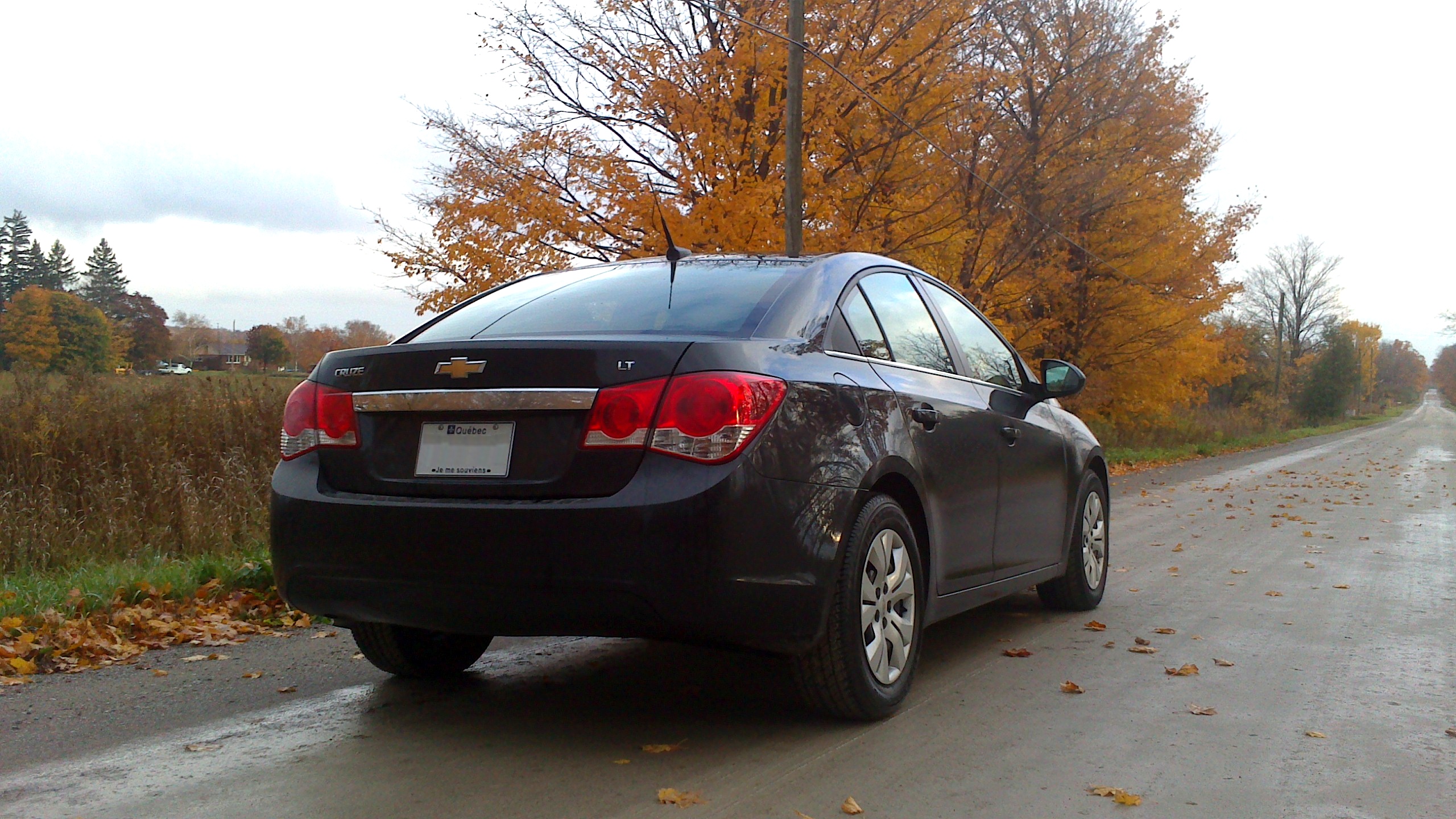
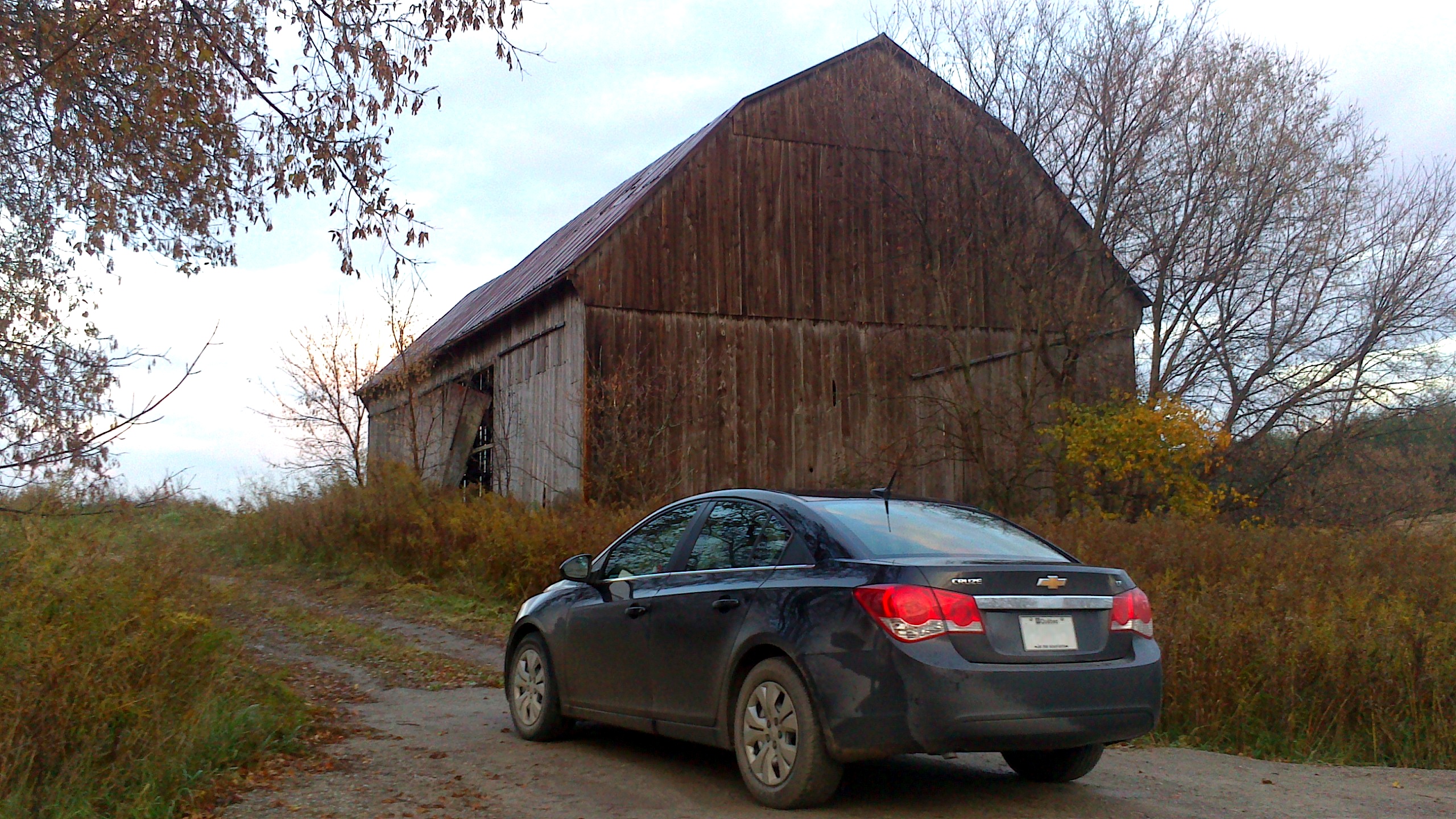
So there I was, in the rental car office, being told I had the choice between two cars: A white one and a black one. At least that gave me more options than the early Ford Model T buyers I guess. The white car was a Dodge Avenger, a car with a superb name, but known for being all plastic inside, and the black car was a Chevrolet Cruze, a car I secretly had wanted to drive for some time. Needless to say, I chose the Chevrolet.

The thing is, even though Chevrolet like to toss the Volt around as the sign they have changed, the real story is different. There is one car credited for turning GM around. It is a car not Made in America actually, but is also often praised in being a decent vehicle. You see, the Cruze is a genuine global car. It may have been designed mostly in South Korea, by the old Daewoo division of General Motors, but it was meant to fit anywhere in the world, something Chevrolets of the past have had trouble doing. That is why I often see the Cruze in France or Canada and when I was in India, they were all over the place! Ford like to say the Focus is their “one car for one world”, but for an American company, GM beat them to it. As a global car, the Cruze was therefore intriguing to me. Was it a compromise, like the Focus? Would it handle well, being American? The questions were there, now I needed the answers.

From the outside, the Cruze looks pretty decent. Yes it is not a good looking car, but it is not bad either. It is a car that could fit in central New York, as much as rural Afghanistan. Yes, the front grille may be big, and the rear particularly bland, but overall, it was okay. On a personal note though, I found the front to be sharp and edgy, which contrasted too much with the more curved rear. It looks a bit as if two separate designers drew the car.

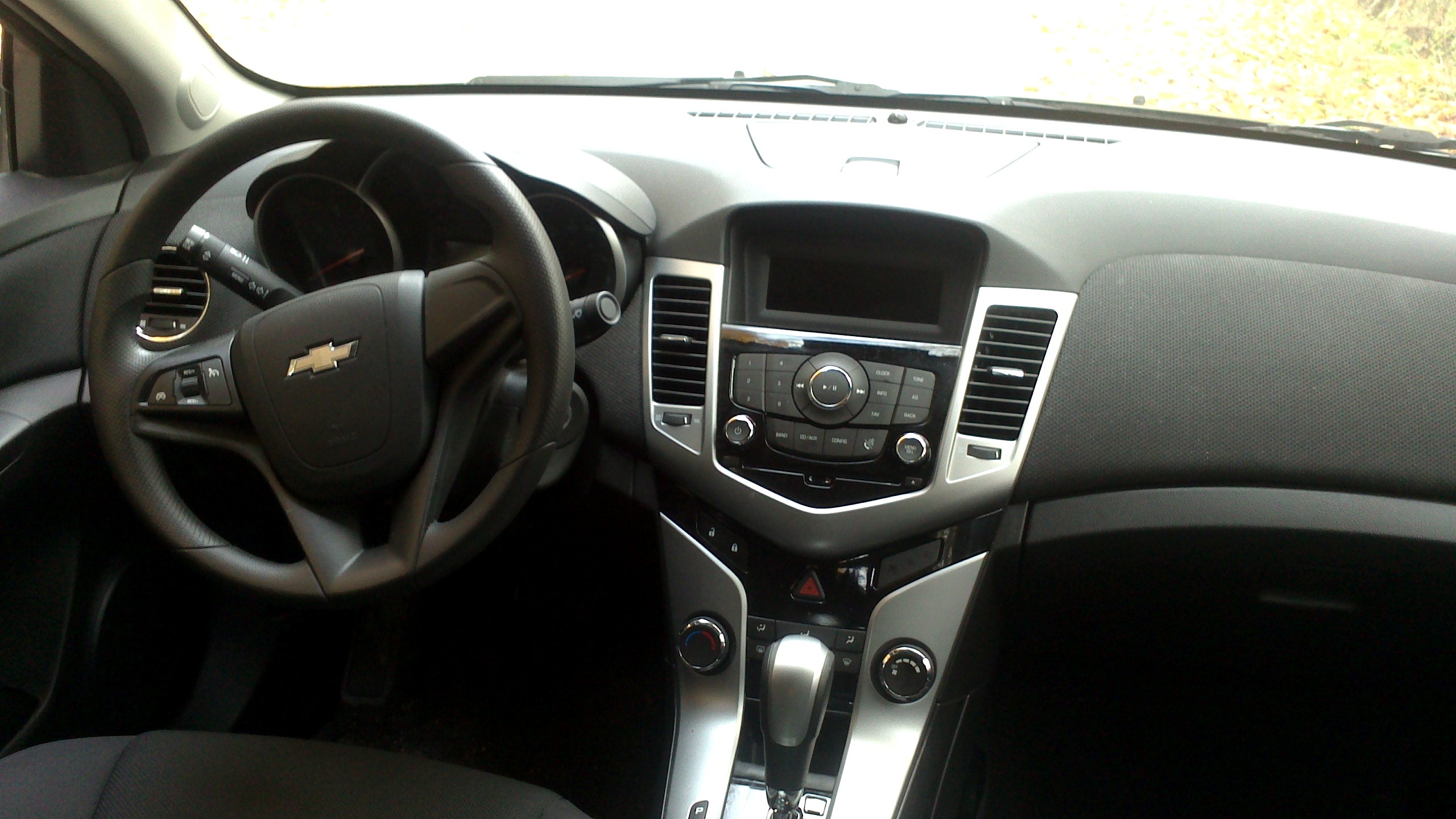
Once inside, I was pleasantly surprised. The seats were comfortable, and the materials were pretty good. Yes it was still hard plastic, but it felt less rough than Chevrolets of old. The front dashboard keeps the Transformers-y theme of new Chevrolets and can seem too clustered for some. However, when driving I found that the buttons were placed logically, all in easy reach. The front seats were good, but offered little bolstering, sort of annoying when cornering. The rear seats were spacious enough to fit three people comfortably. My only big gripes with the interior were the weird mesh material on the dashboard and the centre armrest. Because of American love for cupholders, the centre armrest is half cupholder, which means it is hard to rest your arm on it. A detail yes, but you do notice it on long trips.

Regarding long trips by the way, they are great in the little Cruze. The stereo is nice and powerful, the equipment is enough to keep you entertained (such as the cruise control), and the steering wheel feels great. Then again, it should be good; it is the same one from the Camaro, which I also drove. On the highway, cabin noise is limited, which is good on long trips.

Once you start pushing the Cruze a bit more though, both the good and the bad reveal themselves to you.
On the one side, my greatest astonishment was how the Cruze handled. On small winding roads it changed direction with little drama and handled nicely. Okay, it was not amazing, mostly due to the fact that this is a heavy car, 1.5 tons in fact, but compared to the American cars we were used to, it’s great! In corners it may have a lot of body roll, but that’s mostly due to the fact the car is designed for a comfort more than sporty use.
The suspension does its job well on bad roads and filters out bumps very nicely. Steering is easy to use around town, but just feels very vague when driving enthusiastically. It lacked precision is what I am trying to say and I would attribute that to the electric steering my car had. All in all, the Cruze is a great distance cruiser, perfect for American roads.
However, the grass was not all green on this side. The first thing I hated was the automatic gearbox. Now, I am not a fan of automatics, but this one was particularly bad. It was slow to react, shifted whenever it wanted, and was very clunky and jerky at slow speeds. Put on the manual mode and it would get a little better, but still very slow to change. The gearbox revealed another problem with the car. Mash your foot down, and suddenly this screechy wail of a sound resonates in the cabin. The engine, a 1.4l turbocharged 4 cylinder developing 140bhp, is quiet below 3,500rpm, but above, the sound it produces can be likened to the shriek of a Lord of the Rings’ Nazgul, ie not good and deafening. The other problem with this engine is the lag. Below 2,500rpm, put your foot down and nothing happens for a good five seconds. I thought modern turbos did away with that issue; turns out not quite.

All things considered, the Cruze is a nice little car. It is comfortable enough, handles well enough and looks just enough. The only problems are the engine, gearbox and limited handling. Seems like all the car needs is decent suspension, a manual transmission and a V6 to please me. But then again, if you want a car to go from A to B in comfort, and do not really care about cars, then it is perfect for you. Which is why GM are selling Cruzes by the millions and it is the car that literally saved them. It is also why the Cruze is the perfect rental car.

Posted in Car reviews | Tagged , , , , , , , , | Leave a comment

Driving the American way: The best way to travel?

So I have moved to Canada for now, the second biggest country in the world. It also has a population of only 33 million inhabitants, which is about half of that of France. This means it’s not a very densely populated place, which equals to vast empty spaces all around the place. To say it can be desolate would be an understatement. I thought Northern Scotland was empty, but I had not yet driven 20 miles without encountering a single vehicle.

It also means, when you look at a map, distances are not what they seem. When I first looked at doing a Montreal-Toronto trip, I thought it would take about 3 hours. Turns out it is more likely to be 7. On the freeway, the speed limit is only 100km/h, or 60 mph. It is also very straight. This looked like a very boring trip.

The car I had, a 2012 Chevrolet Cruze is not the most exciting out there, though more on that in a later post, so I was preparing myself to be bored out of my mind during the road trip. The combination of an automatic gearbox and cruise control almost had me fetching my pillow before leaving.

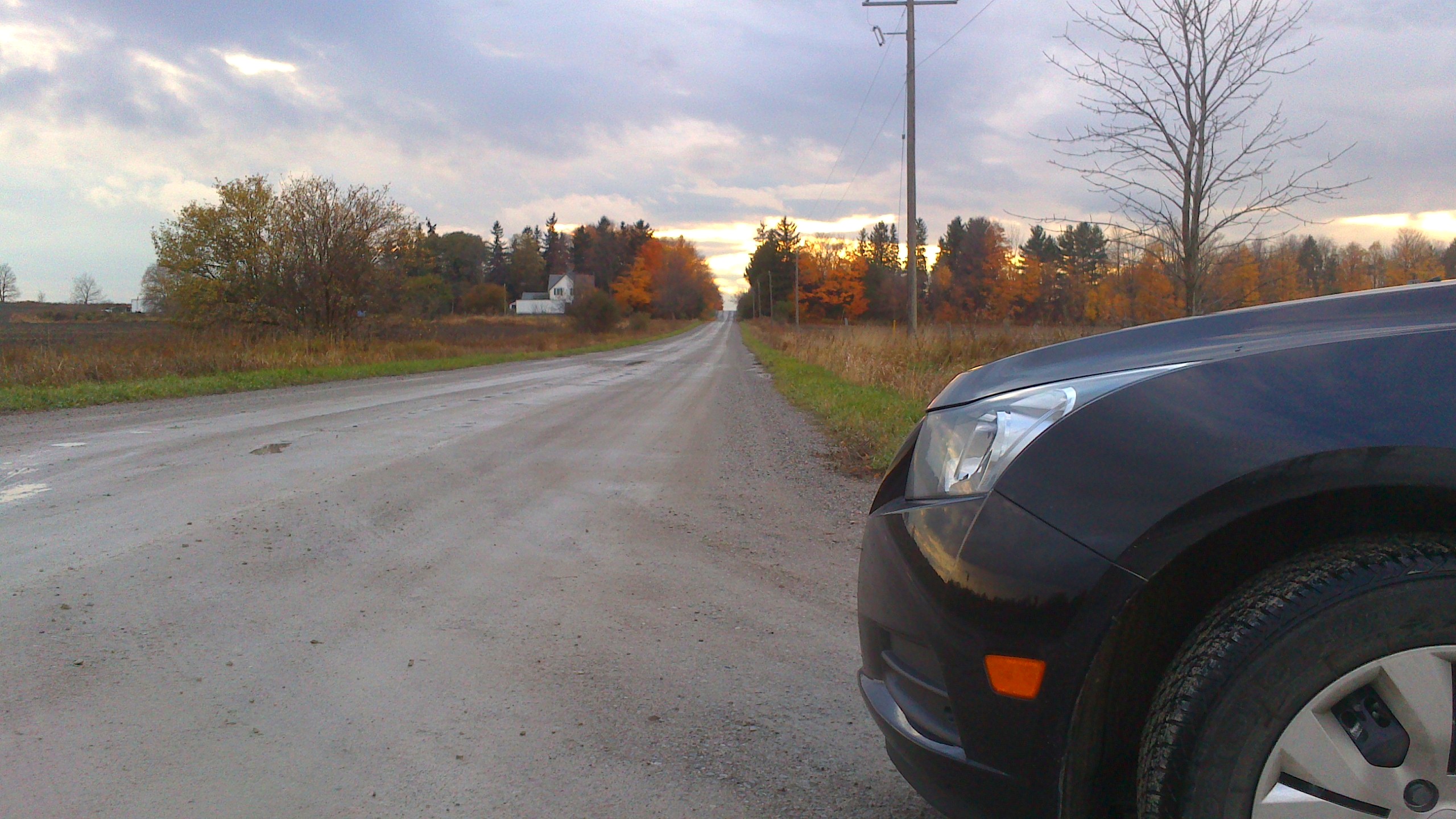
However, once on the road, it was actually pretty interesting. Canada is very big, but also a very beautiful place. Cruising along the freeway with no rush was a soothing experience. Take the car up to speed, set her in cruise and then just take in the scenery. It is now autumn, so the trees were wonderful orange and red colours, the sky was blue and the fields were golden. The car, being automatic was quiet and relaxed. I was not really driving, more like just enjoying the ride. The amount of country music on the radio also made me feel like an American traveller.
Driving that little bit slower was the difference between rushing to a place, and enjoying the drive. Sure, driving along small winding mountain roads in a lightened BMW M3 would have been much more fun, but for 6 hours straight, it would tend to wear a bit, and I would arrive looking as if I had completed a marathon. On this long stretch of road, taking it easy and relaxing was a good way to do it.

But then I decided to get off the freeway and just go along the very small country side roads running alongside. This was one of the greatest ideas I ever had. Yes, you need to have time to waste, as it can take twice as long and yes you are driving pretty slowly. But driving on the lonely roads, passing through a sleepy town from time to time, and enjoying the magnificent scenery was an incredible experience. You took your time, you looked around. Sometimes the road would stop and would actually turn into a dirt track, but that was okay. I felt completely free, no pressure, no queues of cars before or behind me, no pedestrians running around, nothing. It was just me, the car, the road and Canada. To paraphrase the Ontario motto, it was ‘Mine to Discover’.

And right there, among this vast space of discoveries, I realised something. Yes, the roads were always straight, so it could be boring. Yes, the car was pretty comfortable, so I was not involved with the road and yes the automatic gearbox meant I forgot all about the connection between me and the car. It was different. I was no longer driving, I was travelling. The focus was no longer on the driving experience, but the experience around me. The American way of driving started to make sense. Why would you want a lightened sports car if you are going to drive 150 miles in a straight line? Why would you even need an manual? Driving the American way meant going places I would have never gone before, exploring new areas. When I saw something in a sleepy little town that interested me, I would stop. If I found a new road that took my fancy (maybe even with a corner in it), I would just go. It was complete freedom. And because the country is so huge, the possibilities of doing this are virtually endless. I wrote some time ago how driving at night was a form of therapy. Well, in my mind, driving the American way can also be considered as one. There is nothing to care about, no pressure and no worries. It is all incredibly relaxing.
If I was in a car that asked for a lot of involvement, I would not enjoy the trip as much, but I would enjoy the car. Funnily enough, in order to make the most of the travel experience, you need to detach yourself from the act of driving. You could also see this another way; maybe the car was so bad that I tried to focus outside to avoid depression, but in keeping with my objective theme, I will go with the first reasoning.

The focus of this blog is to enjoy the act of just driving to a location and how the ways to do this change. At the basis, there are two ways to do this: Enjoy the ride (that means the car), or enjoy getting there (that is the countryside). With changing times, it seems the focus is more on the latter solution. Think about it, with an electric car, you would be forced to enjoy the scenery, as you stopped every 100 miles to recharge. But does it have to be so? I think both can be done, and I will prove this someday!

But as long as I am in Canada, with so much exploring to do, and access to some pretty dull cars, looks like I will just enjoy getting to places.

Unless Toyota or Subaru reads this. Driving a FRS/GT86/BRZ around Quebec probably would change my mind! I could also settle with a C7 Corvette, if you are reading me, GM.

Posted in Philosophy of driving | Tagged , , , , , , | 2 Comments