Alpine America: Keeping the flame alive

Alpine America

Alpine America Workshop

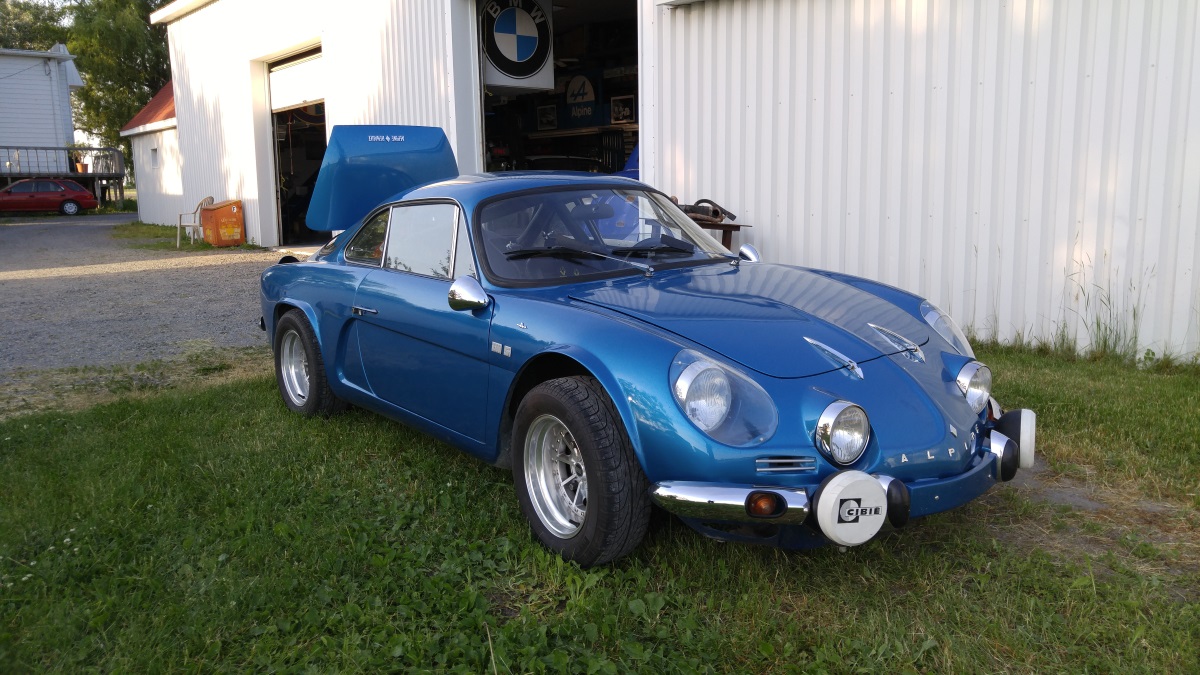
There is something about classic cars. Thinking of it objectively, they are just hunks of metal, through which fluids flow, combustion happens and they move. When you think about it, they have more in common with a lawn mower than a piece of art. And yet, they inspire in us so much. When we see an old classic car, be it a Beetle, a Mustang or a Renault, it makes us feel something. I like to think of it in the same way as Proust’s Madeleine, one whiff and you are transported back to your childhood, your family home and your parents. When we see a car from our childhood, we are just transported back to another time, when things were less stressful, when we could just have fun, when we had time. However, the problem with old cars is that they are, uh, old. Therefore, they need parts, maintenance, TLC. And when those old cars come from another continent and are not made anymore, you need serious devotion, passion and skill. That’s where Michel and Alpine America come along. He helps keep memories alive.

Mexican Alpine A110 1600S

Mexican Alpine A110 1600S

First, a bit of context. Today in North America, the only sign of Renault you will find, is in part of the name of the parent company of Nissan (Renault-Nissan). More curious people will also know Renault as the builders of some of the engines in Nissans and in F1, that’s about it. Forty years ago, that was not the case, Renault was actually a big part of the North American automotive landscape. In fact, when you watch that 90s classic, Dude Where’s My Car, you’ll notice that the star of the movie is a Renault LeCar. Renault has been present in North America since 1906, selling their most prestigious vehicles and soldiered on, with cars like the Dauphine, 4CV, Fuego, Alliance (R9), and even later models like the Medaillon (R21) and Premier (R25) until 1992. In the end, emissions, crash-test standards and the American thirst for V8 motors and big vehicles made sure Renault would not come back. This means, for almost half a century, North-Americans grew up with Renaults, had parents who drove the cars, saw them in the streets and movies. But after 1992, it was finished. Renaults would become a rarer and rarer sight, relinquished to a time when you could order a Pizza at McDonald’s.

Variety of cars in for care

Variety of cars in for care

This is where Michel and Alpine America steps in. This French national, who moved to Quebec in 1976 was always passionate by cars, and in particular fast Renaults. He started working for Renault in Canada, before moving on to Subaru. During his time working with new cars, he continued doing what he likes: making fast Renaults faster and rallying them. His dedication led him to be crowned the rally champion of Quebec in 1986 in a Renault 5 Turbo. As cars became more and more complex and electronically assisted, Michel decided to leave the world of new cars, and concentrate on what he does best: Keeping old Renaults alive, making them fast, and making sure the French spirit for speed stays alive in North America. Thus, in 2000, Alpine America was born.

Renault 5 Turbo

Renault 5 Turbo

As the name suggests, Michel likes to focus on the pinnacle of fast Renaults, the Alpine. Created by Jean Rédélé in 1955 with the A106, Alpine was the result of taking an ordinary Renault, removing the superfluous parts, improving the engine to new heights, and overall turning it into a race car. This venture culminated in 1962 with the Alpine A110, which went on to become a rallying legend. The story continued with the unloved A310 and A610, to end sadly in 1995, but that’s a story for another day. Anyway, officially, the Alpine was never imported in North America, and with the A310s gathering dust in Europe, Michel decided to import what he could find. The response was more than positive, and Canadians and Americans just wanted more and more of this small V6 powered, rear-engined, rear-wheel-drive car. Michel went on to improve the A310s, by working with Willwood for better brakes and improving the intake manifold to make a classic, but potent little race-car. Being one of the only Renault specialists in North America, Michel also gets to work on the unicorn A110, as well as related cars, like Lotus Europas or Matra Jets.

France and USA

France and USA

In addition to the Alpine, Michel loves to work on old Renaults. One of his specialties is taking the ordinary LeCar, and transforming it into the brutal Renault 5 Alpine that only France got to enjoy back in the day. Having seen his work, one only has to wonder, why would you consider a Mini Cooper instead? After all, once it has passed through his hands, you are talking about a car that has at least 130bhp and weighs only 850kg. Making sure these classic Renaults can keep on bringing smiles to everyone is hard work. As you can imagine, parts are increasingly hard to find. Every year, Michel and a few friends go back to France and comb through the country trying to find salvageable cars from which they can retrieve working parts. In addition to this, Michel imports a considerable number of cars from Europe, based on what his customers want. In some cases, he will even fly to Europe, in order to give his seal of approval on rare Alpines for American customers. Taking into account this, and all the restoration work he does, it would be an understatement to say that Michel is a busy man.

Projects, just waiting to live again!

Projects, just waiting to live again!

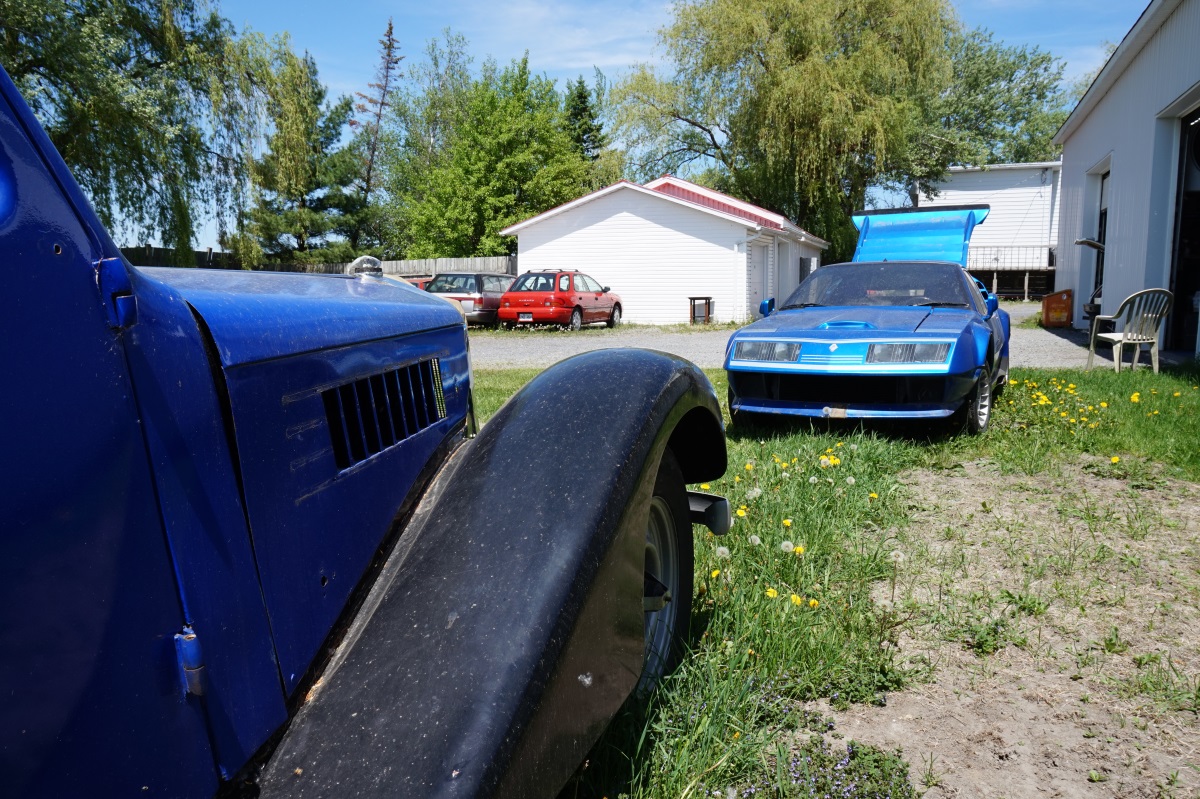
Seeing him work on preserving and improving the life of all these classic cars is a genuine treat. Even though he loves his Renaults, Michel will work on about anything, including a 1930s Delage D6, a Ferrari 550 Maranello, a 1965 Ford Mustang, a BMW 2002 (in which he wants to put an E30 M3 engine in) and the odd Subaru Impreza or Legacy. As he told me, project cars are not what he lacks. Looking around his garage, you can count at least 20 cars that are getting worked on, or stored for later. And with the exception of a few friends and family who help him from time to time, Michel tends to work alone. The artist preserving lost memories.

Posted in Philosophy of driving | Tagged , , , , , , , , , , , , , , , , , , , , , , , , | Leave a comment

The case for Automobile Association membership – Part II

The empty Canadian highway

The empty Canadian highway

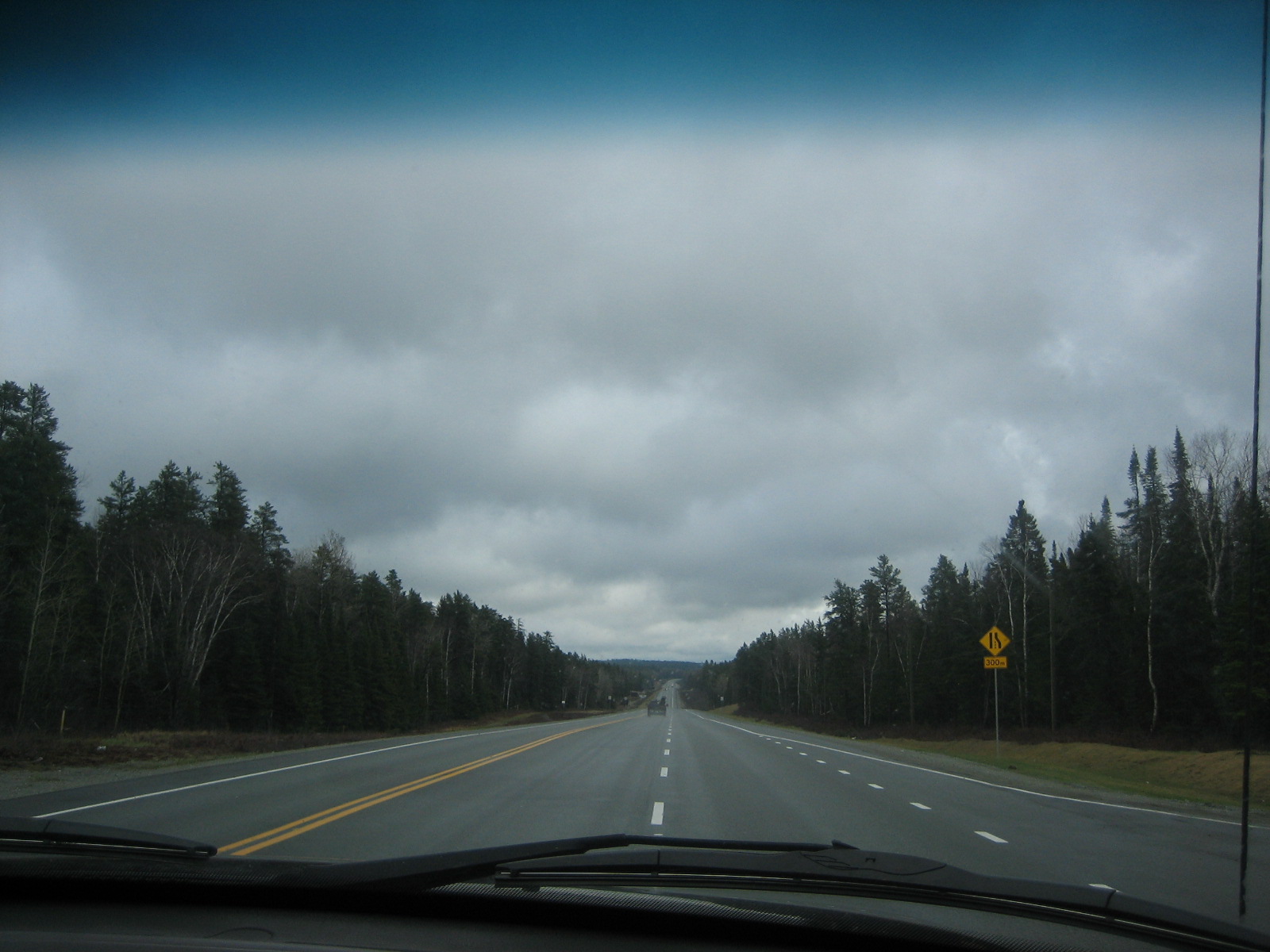
Travel is all about time and space. The West and the Prairies have nice defined borders, and mostly two lane highways. Ontario is another story. It is a very wide province and although there are passing lanes, the Trans-Canada highway is mostly a two-lane road outside the big cities.

So, we hold our breath as we enter Ontario. First marker is Kenora; some 200km from Winnipeg. The clouds slowly take over and our enjoyment of the sun is short lived. Next on the map is Dryden where we stop to refuel. 70km past Dryden, we pull at a provincial rest-stop right next to Highway 17, which is also Hwy 1. There are a few travelers there and we drive past them to find a nice spot by the side of a lake. We have something to eat and use the facilities. It is cold and rainy. The ice on the lake has thawed and so have the black flies.

We get back in the truck and as we make it on the Trans-Canada highway I notice that the engine doesn’t have its usual zip. We travel a stretch of road that is fairly flat so the truck is not struggling too much, but it is still under-powered. There is road work up ahead and a flagger stops the traffic on our side. There is only one lane open. We wait for a while. After the traffic from the other lane has passed, it is now our turn. It has become even more obvious that the truck doesn’t have much energy, especially since it’s loaded and pulling a trailer. Because of the road work, we are travelling at a slow speed. After a while, we get past the road crew and are directed to get back in our lane. Not too far ahead, there is another provincial rest stop and I decide to pull in there. There is definitely something wrong with the engine.

The entrance to the park is paved and fairly wide. I turn the whole rig around and pull to the side. This way, we don’t impede visitors to the park, and if we need to be towed, the truck and trailer will be facing in the right direction. I look in the engine compartment, but I can’t see anything wrong. There’s plenty of oil, plenty of transmission fluid and plenty of engine coolant. After some mumbling and grumbling, I try to use my LG phone. It’s a Telus phone and I should be able to use it on any network in Canada, but there is no signal. I try my wife’s phone; same thing.

I decide to walk back to where the roadwork is taking place to see if I can get some sort of help. I cross the highway and approach the flagger. After explaining the situation, he hands me his phone and tells me to use it. He said he’s got unlimited minutes with Virgin Mobile and he gets a signal with no problems. I call BCAA and they have a truck with a flatbed and a tow ball showing up within the hour. I thank the flagger profusely for letting me use his phone.

Unlike the first BCAA tow man we encountered, he is well equipped. But unlike the other man, he is not very happy to be there. He is overworked and doesn’t want to take me to his garage because he has too many clients waiting already. The only option is to go back to Dryden at either the Ford dealership or the Canadian Tire. There is also a third place he suggests, but I choose to be dropped off at the Ford dealer. He drives the truck on the flatbed and hitches the trailer.

Lakehead region, Ontario

Lakehead region, Ontario

The rain is picking up and the trip back to Dryden is slow and somber. By the time the tow truck driver drops us off at the dealer, they are closed and it’s getting dark. Now, the rain is coming down like buckets. The driver of the tow truck does a good job parking the trailer. It is nicely tucked away at the back of the dealer’s lot. I drive the truck off the flat bed. The man leaves.

The wife is miserable. The cat is miserable, and I ain’t happy about this latest turn of events.

My wife just wants to go to sleep in the trailer, but the load has shifted and the trailer is a mess. I tell her that I’m going to go rent a motel room. On the drive back to Dryden, I saw a motel near the Ford dealer. Although the truck is underpowered, I drive it. As I get near the motel, I see that it is closed, but past it, there is a small motel tucked away on a corner, across from the KFC. I knock on the office door and a man answers. He tells me that there is a room available and I promptly rent it. I go back to the trailer to pick up my wife and Java Man.

They have a good night sleep. Me. Not so much. The next morning, the rain has stopped, thankfully, and I show up early at the Ford dealer. Like most dealers, they are booked for the day, but after they hear my story, they “squeeze” me in and fix the truck. It turns out that it was the coil on plug on the number six cylinder that failed. It is beyond me why engineers decided to get rid of distributors and the cap for a coil-on-plug for each cylinder. So, a couple of hours later and $400 tacked on to my credit card, the truck is ready. It drives like its normal self, again.

Probably the best store in the world

Probably the best store in the world

There’s about an hour to go before we have to check out of the motel, so I decide to give my wife and the cat a bit more time to rest. In the mean time, I fill up the gas tank and I go to the Canadian tire to get a new hitch and tow ball. The one I had on was a bit loose and the last thing I needed was for the ball to break. I also get more water and snacks for the trip. I go back to the motel and we pack everything up.

We’ve lost another day, but we are happy to get back on the road. A bit tentative at first, we finally relax a little bit. What the hell else could happen? We stop at the Shell station in Upsala, originally a station for the Canadian Pacific railway. It was named after Uppsala in Sweden. Many of its residents originally came from Scandinavia. After filling up, we go into the restaurant for an excellent meal, including home-made bread.

Satiated, we get back on the road and make it to Thunder Bay; a four-hour drive from Dryden. We push on to Nipigon. It’s another 120km away. I feel like we’ve got nothing to lose at this point and I decide to leave Highway 17 and take Highway 11. This way, we will avoid more traffic and a bunch of towns along that stretch of Trans-Canada highway. We will also avoid driving through Ottawa.

Highway 17

Highway 17

After fueling up in Nipigon and taking a bit of a break, we soon realize that taking Highway 11 was a big gamble. There might not have been much cellular signal for our crappy phones, but there was more traffic on Highway 17. Highway 11 feels like the end of the world. There’s nobody there. The sun is setting, but I keep on driving. We make it to Longlac; 200km away. I’m getting tired and it’s getting darker. Longlac is nice. There’s a lowly church by the lake. It must be real harsh in winter. I drive past Longlac hoping to find another gas station apart from the one we saw at the entrance of the town, but there is none. We do find a pull out on the left side of the road. We decide to go back to fill up and then we will return to the stop to spend the night.

We fill up in Longlac. There are lots of native kids hanging around the gas station, looking bored. We drive back to the rest stop we had used for a round-about earlier. Soon after we settle in, a big rig pulls up at the same stop. Truck drivers have this habit of leaving the engine running and they seem to sleep through it. This guy probably wanted to take a leak or grab something. In any case, he doesn’t stay long and leaves.

As I’m drifting off to sleep, leaning against the driver side door, another rig pulls in right beside us and releases the pressure in his air brakes. There are so many lights on his truck that it would make your average Christmas tree envious. He backs up the rig behind us and leaves his engine running for quite a while. Although, I’m very tired I cannot sleep with all that racket. And I’m sure my Cat doesn’t like it much either. My wife will sleep through an earthquake. The inconsiderate moron finally turns off his lights and the engine. By now, I’m still tired, but I am fully awake. I’ve had enough of this and we get back on the road.

Danger, Moose crossing

Danger, Moose crossing

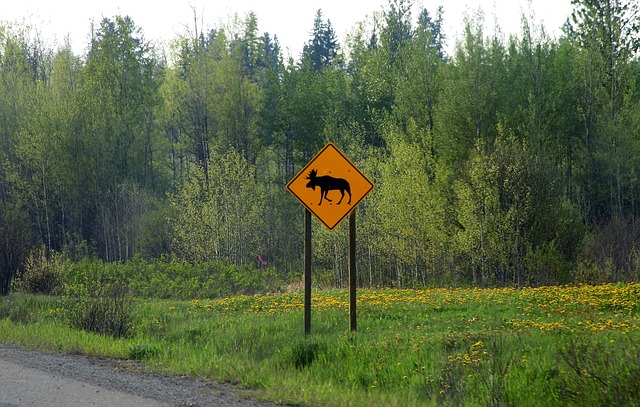
We make it to Hearst in the wee hours of the morning, 200km from Longlac. There was nothing but nature in between with a lot of signs warning drivers to be careful about Moose crossing the road. We start making fun of the moose on the loose and any combination of words thereof. Fortunately, we do not encounter any. We pull into a rest stop just before Hearst and catch a couple of hours’ sleep. We are dead tired, both physically and mentally, and need to shut down.

From Nipigon to Hearst, the road is pretty good. From Hearst on, it’s garbage until we reach Kapuskasing. Then, it becomes wavy. Sassy, but not brassy. I’m still tired. I think my wife is becoming seasick. We stop in Smooth Rock Falls, 160km from Hearst, for a well deserved break at the Esso station. There is a diner adjacent to the station. The food is plentiful, good and reasonably priced. Like the Shell station was in Upsala with its diner, those two are becoming a rare breed.

The humdrum of the trip returns when we depart Smooth Rock Falls. What a quirky name for a town. Whatever enjoyment we felt for the trip is long gone and now my only goal is to make it to destination on that day. We had left Hearst at around 5:30am and I was determined to make it to Lachute, over 1000km away, before midnight.

The stretch of highway between Cochrane and Iroquois Falls is the pits. They can put a man on the moon, but they can’t come up with a black top that will withstand the rigors of winter and of traffic. And there are no rest stops open. I guess they close them all for winter and reopen them at some point. There is no snow on the ground, so we do not understand why they have the stops still gated. The only places we can stop are the turn-around for the snow plows. It is apparently illegal for us to stop there. Obviously a great number of travelers have also stopped because the road side is littered with garbage. There are no refuse bins at those locations.
Rest stop where COP failed

Rest stop where COP failed

We should have turned at Matheson to head for the province of Québec, but instead use the Kirkland Lake route. We get on Route 117, as I wouldn’t call it highway 117. We have Rouyn-Noranda in our sight. We stop along the way to fill up. In Rouyn, you have to drive through town, and it is a fairly large town. There is some sort of by-pass, but I don’t want to risk it. The travel map we have doesn’t give any details of that town. We make it past Rouyn and shoot for Malartic. Once we’ve made it past Malartic, we set our sights on Val d’Or (Valley of Gold). Gold mining was big in the middle part of the 20th Century in that region.

I’m going at speed limit, despite the awful road, but some moron in a grey pickup truck keeps honking behind me. I’m not going fast enough to his liking. He finally passes us. He’s the only stupid motorist we’ve encountered so far, except for the two big rig drivers who thought they owned the rest stop in Longlac.

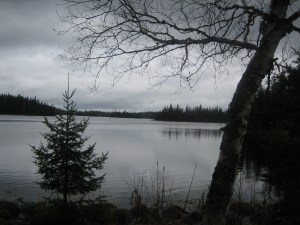
As we travelled from Hearts and into Québec, we couldn’t find one rest stop that was open until we drive past Val d’Or. The scenery is beautiful despite the narrow road and the tractor trailers zooming by. They’ve got a deadline to meet or they are getting paid by the mile, or both. There is a small rest stop right next to a lake. There is a sign that reads “closed” but I don’t care and pull over. For some reason, the barrier is open. We park the truck and are happy to find that the women’s stall is unlocked. We admire the lake. It is cloudy, but not raining.
La Verendrye Reserve

La Verendrye Reserve

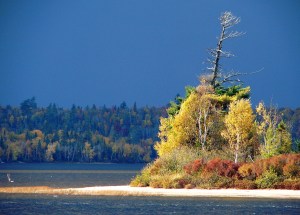
After a bit of rest, we get back on the road. Next goal is Mont Laurier. To get there, we will have to drive through the La Vérendrye Wildlife Reserve. It’s a long stretch with no gas station, but we’ve got plenty of fuel in the tank. Besides, I have a 5 gallon jerry can at the back of the truck.  At the beginning of the Reserve, there is a large rest stop on the left side. There isn’t much traffic, so we cut across the oncoming lane and park at the rest stop. It is surprisingly clean and there is a large building housing the rest rooms. They are also clean with lots of paper, running water and soap. We decide to have a bite to eat. A pair of ravens appears, calling out for their share of the lunch. We tossed some hard boiled eggs and pieces of apples in their direction. We are used to Ravens. Last summer, we fed three chicks that had landed on our roof. There were a noisy lot and we fed them cat food or dog food many times per day. We would put the food on a big concrete block we had. They would fly down and once the food was gone, they would fly back onto the roof. They still had their blue eyes. After a couple of weeks, they just flew off. They needed to hunt or scavenge for themselves. The roof was covered with doo doo. Over time, the rain washed it all off.

We would have like to hang out a bit longer at the Wildlife Reserve rest stop, but it was time to leave. Again, the road was in bad shape. There were short stretches here and there that had been repaved, but for the most part, it was very bumpy. It’s slow going and there is no signage along the way indicating how far we are from Mont Laurier. I know that it’s a wildlife reserve, but it wouldn’t kill the environment to have some nice signs along the road showing how far you have to go. The only way we realize that we are out of the reserve is that we are starting to see some buildings. The Laurentian Mountains are beautiful even though the leaves are just starting to unfurl.

Before we reach Mont-Laurier the road meanders through a village and there is a snack bar by the side of the so-called highway. We pull in the driveway taking up a few parking spaces. But we are tucked out of the way and the owner, whose nickname is “La Saucisse” tells us that the rig is fine where it is. He and his crew are very pleasant and welcoming. I order a poutine, of course. Québec being the land of poutine, La Saucisse serves the real deal. Portions are large and the prices are great, like the other two establishments I previously mentioned.

Mont Tremblant Natural Park

Mont Tremblant Natural Park

The sun is setting. And to think that we were in Hearst that morning. We’ve got less than 200 km to go before we reach destination. We get across Mont Laurier and reach Mont-Tremblant, famed for its skiing and all year-round resort area. By now, I’m really tired, but the goal is in sight and we finally make it at around 10:30pm. 17 hours on the road that day for the last leg of the trip. We get in the house and unpack the cat and the sleeping gear. We are ready to crash. We don’t know how Java Man will react. If the previous motel stays are any indication, he will not like it. But to our surprise, he immediately takes to the place. He loves it.

We wake up to snow the next day, but we don’t care. We’ve made it. It took almost 7 days to drive 4500km. Despite having had the truck and trailer checked and serviced before departure, it was still no guarantee that nothing would happen. The moral of the story is that I’m happy I signed up for an automobile membership. On the one hand, we were fortunate to be able to call BCAA and on the other hand, we were promptly assisted, regardless of our location. The cost of membership was peanuts compared to what I would have paid if I had not become a member of the Canadian Automobile Association. Canada is the second largest country in the world after Russia, so it pays to be prepared. And having an Automobile Association membership is a good place to start.

Happy Traveling!!!

Posted in The Driver's Edge | Tagged , , , , , , , , , , , , , , , , , , | Leave a comment

Buying an old car (in Canada), what could go wrong?

It's not a Delage or Alpine, so what is it?

It’s not a Delage or Alpine, so what is it?

So as you may have realized, I really wanted to get a car. I even dedicated a post to musing on what would be best for Canada, and the conclusion was the Porsche 944. As is custom with me, when I finally decided to buy a car, I straight-away decided to ignore my careful documentation, and just jump on the first opportunity I got.

As a reminder, here was my checklist:

  • Good Handling: because I like to drive
  • Reliable: because road-trips
  • Fairly rust-resistant: because Canada
  • Comfortable: because Canadian roads
  • Exciting: because I like to drive

Here is how my car fits in all this:

  • Good Handling: I never tried the car before, or any other car from the same brand
  • Reliable: the car does not start, I had to replace the knock sensor, the alternator did not work, and the brakes were jammed
  • Fairly rust-resistant: the car has a hole in the roof, and it’s not a convertible
  • Comfortable: I have no idea, since I never drove the car. Also, no heated seats, electric windows or air conditioning.
  • Exciting: it’s 4 wheel-drive, weighs close to 1.5 tons and only has 135bhp

Don’t you just love it when a plan comes together?

So, as you can see, I basically bought a car sight unseen. It’s from 1998, meaning it’s 18 years old. It used to be driven often, almost every day in fact, and has 240,000kms. I say used to, because the car has been in storage for the past 2 years, hence why I have no idea how it runs. Also, on a fun note, the car cost me less than my desktop computer.  On another fun note, I bought the car in June, and it’s now August – the car is still not inspected to drive on the road.

To briefly introduce the context behind my decision, because I will not reveal the car yet, what happened was I was talking to a friend of mine who owns a garage, about my plans to buy a car. He told me he has a friend who has this car in storage, and he wants to get rid of it. The car needs some small work, but overall, it’s in good shape. I decide to trust my friend, go have a look at the car, and decide to buy it. When I saw the car, I only had a few minutes, and never got it to run, because they still had to work on getting it started. In honesty, most of the problems I knew about, the reason I went forward with all this is because it was a great opportunity to learn how to work on my car. After all, the car is stored at my friend’s garage, and he helps me to work on it. So win-win.

Since I got the car, I changed the driver mirror, changed the front brakes, duck-taped the roof, changed the battery, knock-sensor, refurbished the rear (drum!!!) brakes, fixed the chipped windscreen, changed the engine and transmission oil, and replaced the alternator. There is still a couple of things to do, and overall, it only cost me a few hundred dollars, and a couple of days of time. And I’m happy about it, because I’m learning to work on my car. Having had my brakes changed on my old Golf, I can honestly say I saved at least 500$ with my brakes, and the experience I got with my new car was invaluable.

So why did I choose this particular car? Well, as I said, it’s an ideal opportunity for me to learn to work on a car, before I go onto more exciting projects. The car is from a brand I respect and love, and to be honest, I had no idea I could get a good (ie, unmolested) example of it. I have plans for this car; you can be sure about that. In the future, it will turn it into a sleeper, with more power and sleeker looks. It will be awesome. And I will be able to use it 365 days a year in Canada, rain, snow or sun.

Mount Fuji, what could be the link with my car?

Mount Fuji, what could be the link with my car?

The only regret I have, but then again it was to be expected, was the rust. Even if my car, for its age and for a car that was driven all year round, does not have that much rust, it is amazing to see how bad it can get.

So, to be continued…..

Posted in Philosophy of driving | Tagged , , , , , , , , | 1 Comment

The case for Automobile Association membership – Part I

near Lake Louise

Near Lake Louise

I was going to write about my cross-country trip and its wonderful scenery, but it turned into quite an ordeal. So, I will focus on the adventure itself.

The plan was to travel from West Vancouver, British Columbia to Lachute, Quebec; a 4,500km trip. I have been driving for over 40 years and I’ve never had an Automobile Association membership. I did have friends and acquaintances that swore by CAA.

Since my wife and my cat were going to accompany me, I thought it would be good insurance, as it were, to get a CAA membership.

The rig

The rig

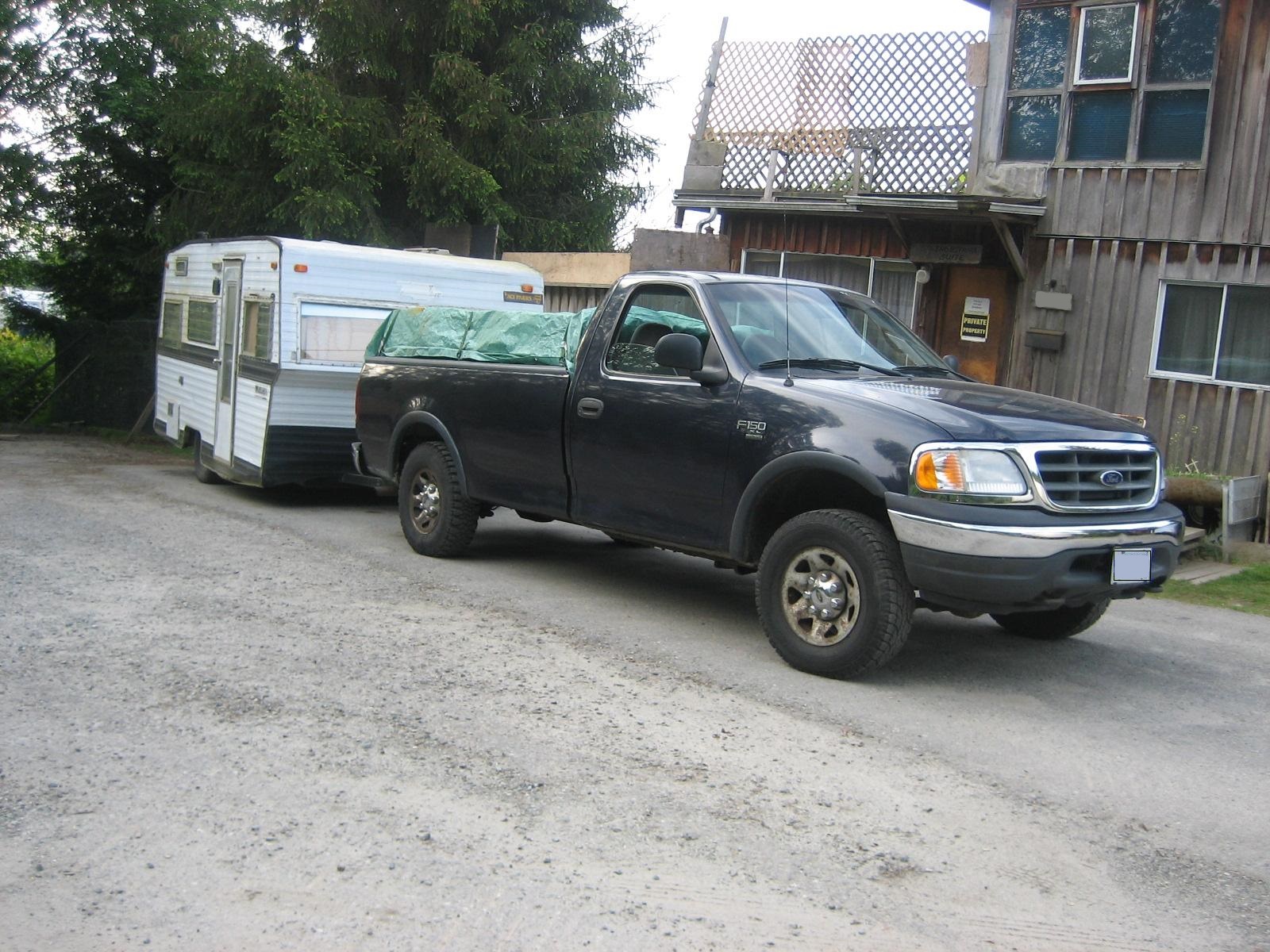
In Canada, the membership is provincial. A few days before the trip, I took the full package which included RV coverage. The Rig: a 1997 Ford F150 and a 1969 14’ travel trailer, with all lights running. To be on the safe side, I visited my neighbourhood auto wrecker and purchased an as-new set of tires for the back wheels. The ones I had on were getting a bit bald. I also had the wheel bearings repacked on the trailer and my mechanic gave me an extra set of bearings just in case.

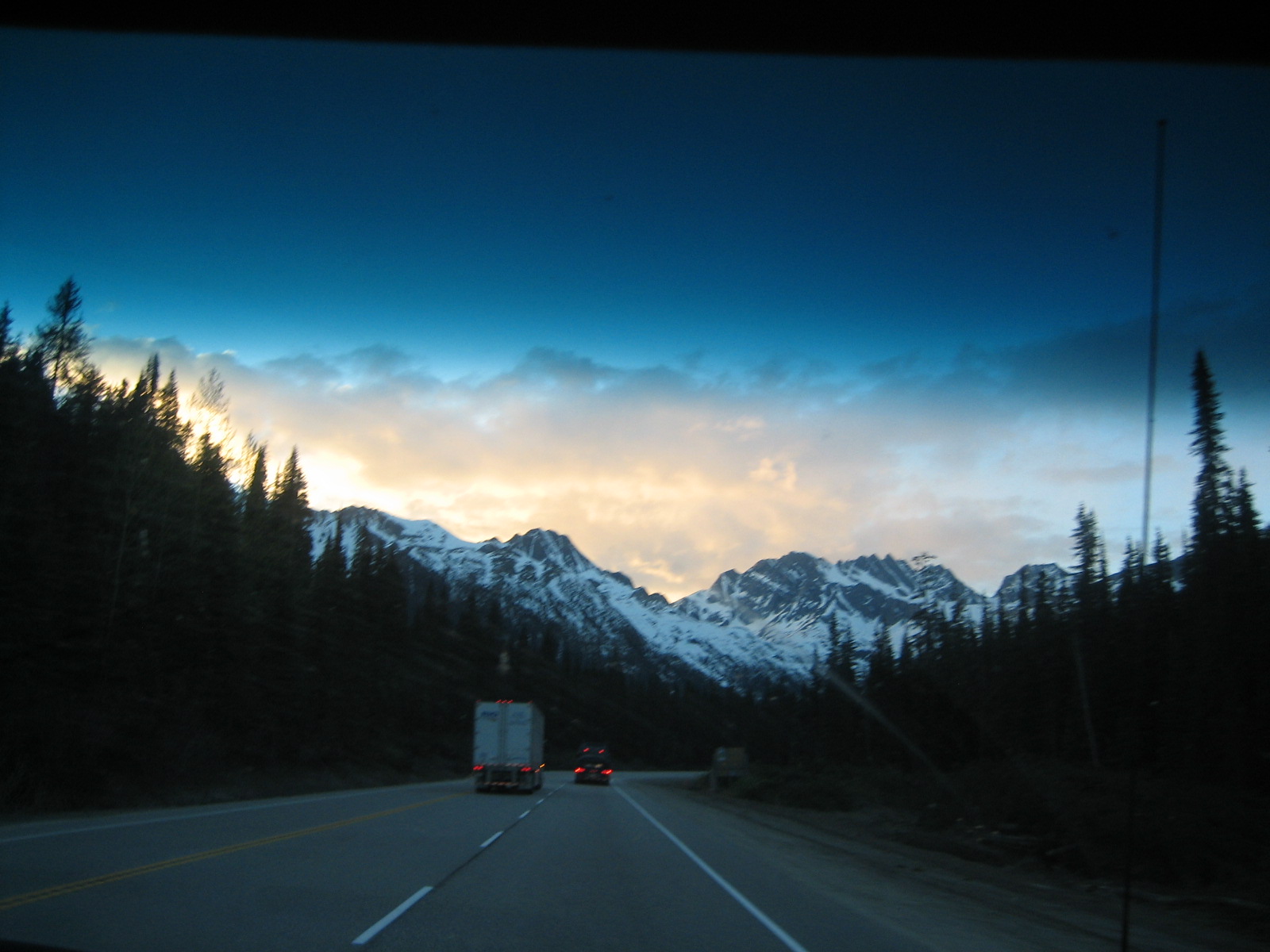
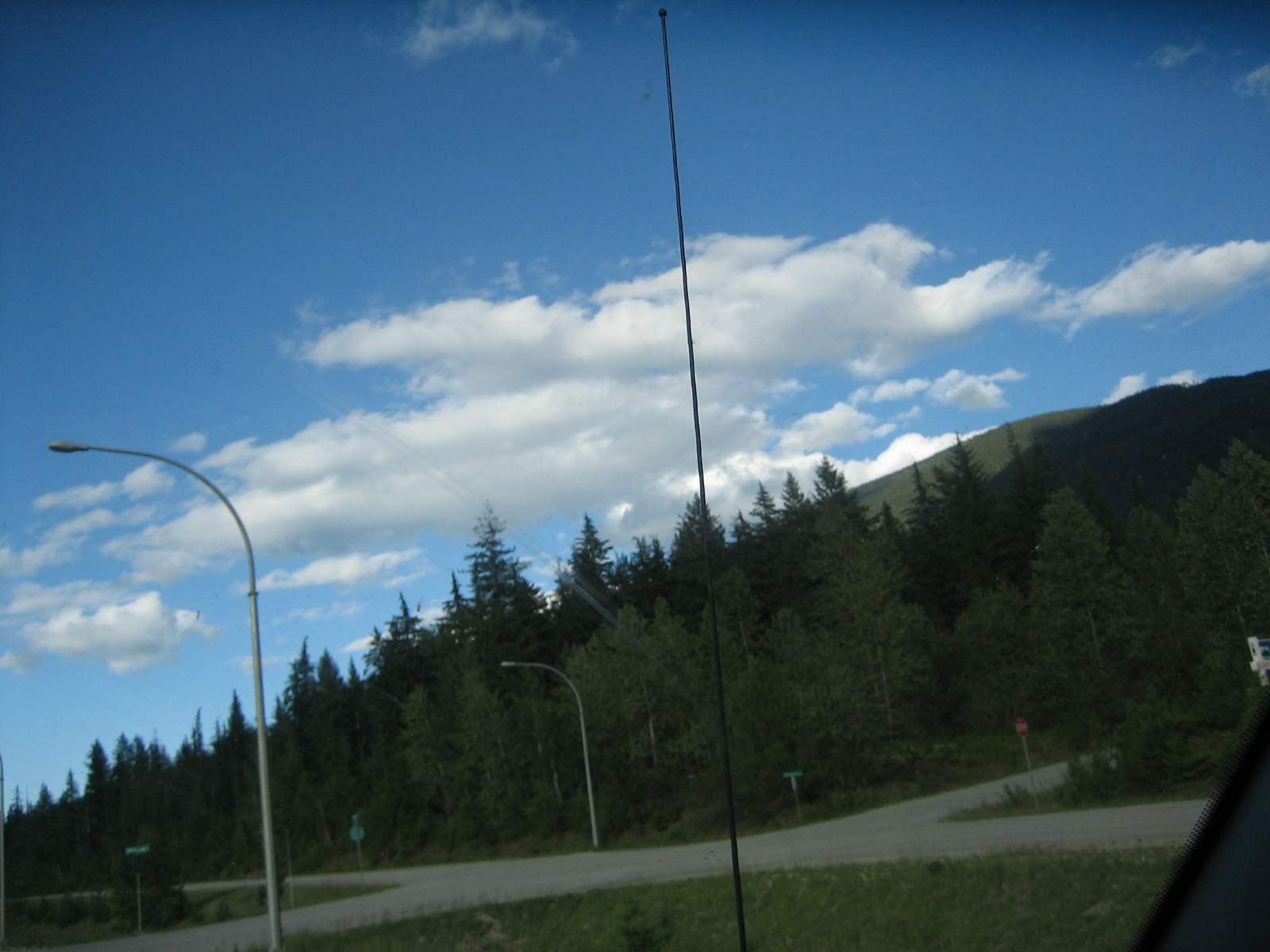
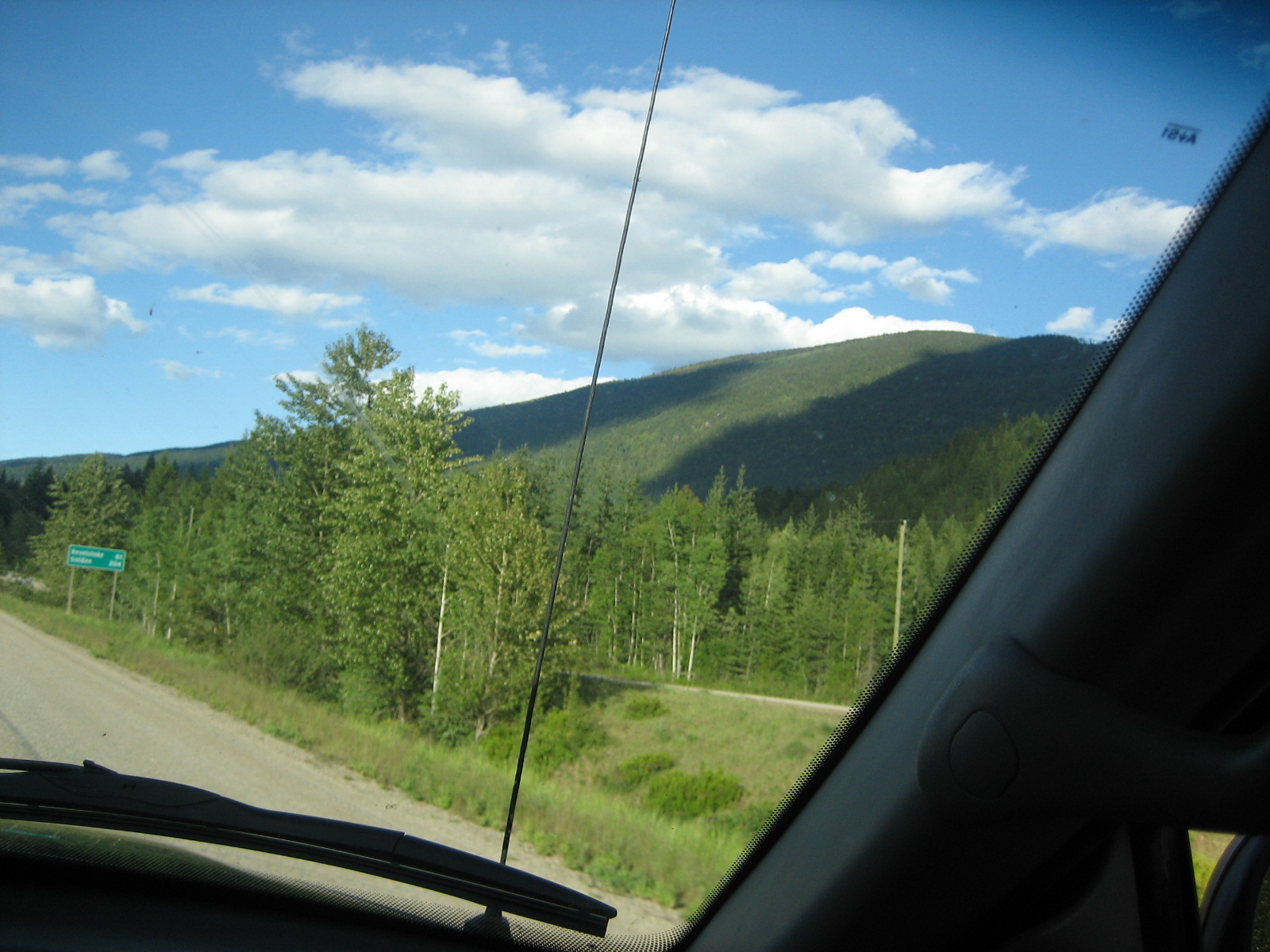
We began the trip on a beautiful Sunday morning. the second week of May. Vacation hadn’t started for most people, since kids were still in school, so we assumed that traffic would be light for the duration of the trip. The temperature was in the mid-teens; perfect weather for driving. We made it through Vancouver and meandered our way up the Rockies. Every time we stopped for gas, we checked the rig and made sure that everything was holding up. We stopped in Sicamous, BC to top up the gas and have a bite to eat. We had traveled about 500km and all was going well.

Blowout

Blowout

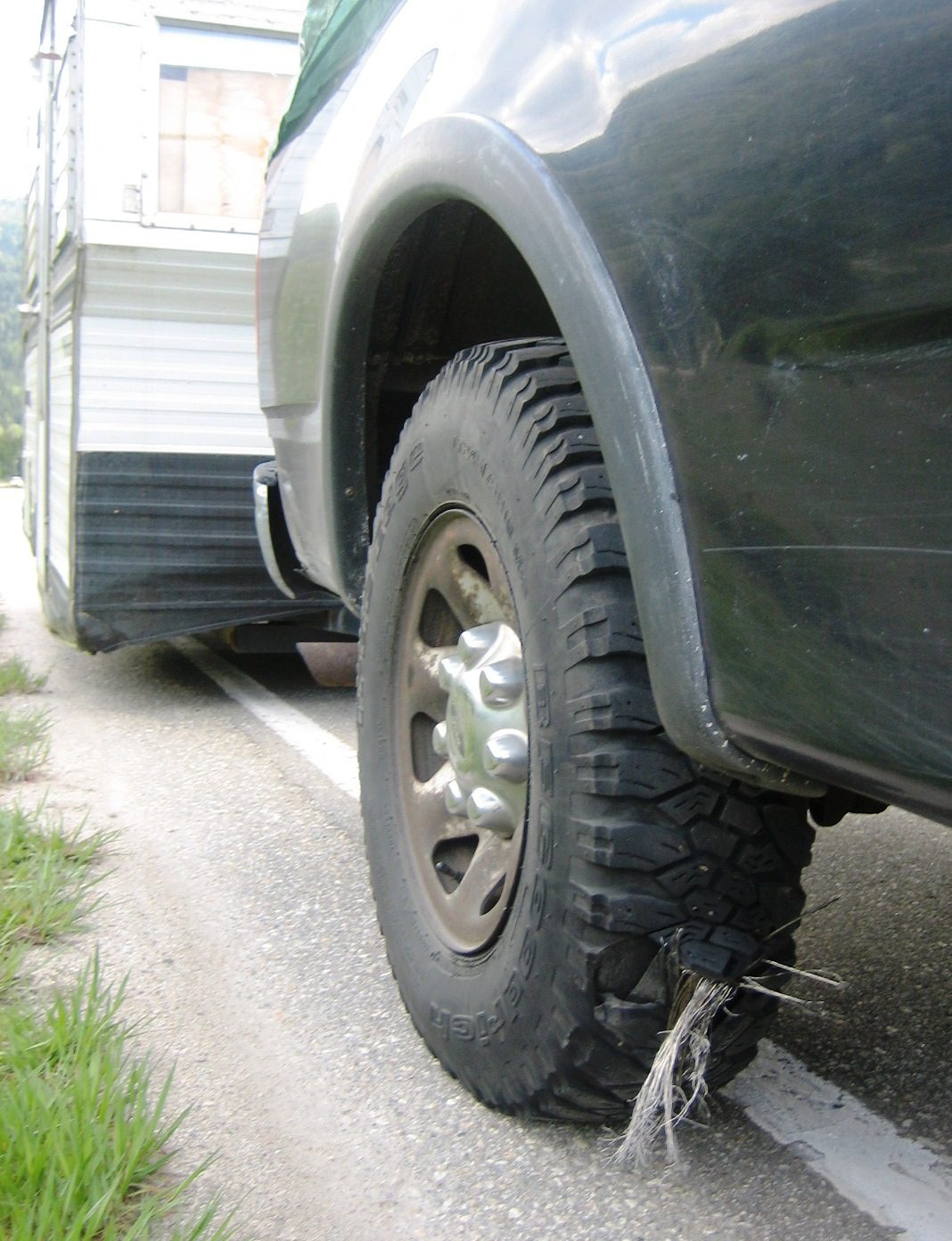
About 12km outside of Sicamous, we hear a big bang and I see a trail of dust coming off the back of the truck. We were on a straight and flat surface with a large paved shoulder. It made it easy to pull over as quickly as I could. Making sure it was safe to get out of the truck as the highway traffic zipped by; I walked to the rear passenger side to discover that one of my “new” tires had blown. Fortunately, the inner tube was still intact and held the tire at the same level as the others. The steel belt had exploded outwards and left a big gaping hole.

Annoyed to say the least, I pulled out my cell phone hoping to get a signal. We must have been close enough to a tower and I was able to dial BCAA. I didn’t even have my membership card which had not arrived in the mail yet, but I had printed the necessary information. The customer service person was very helpful and assured me that someone would be there within 45 minutes. As advertised, a young man showed up in a car. He mentioned that his tow truck wouldn’t start, but he did have all the necessary tools to change the tire. I had a spare underneath the bed of the truck. After unhooking the trailer, he put the spare on and the busted tire under the truck. The spare was low, so he advised that we should turn around and inflate it in Sicamous, which we did. The young man was very helpful and he had to rush. He got a call from BCAA for another flat tire.

CT Parking Lot Camrose

CT Parking Lot Camrose

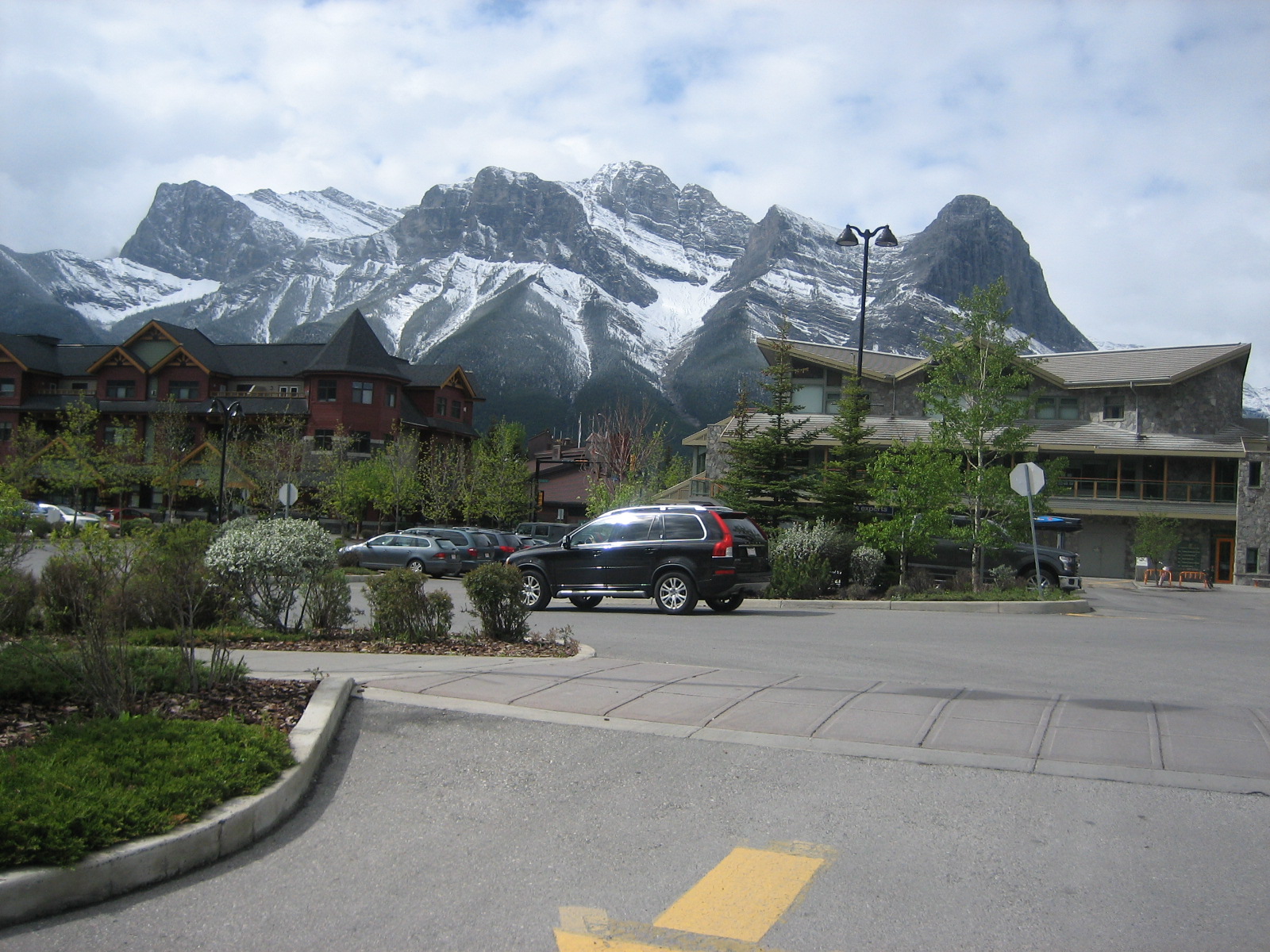
That delayed us for a couple of hours, but we were still determined to make it to Canmore, Alberta before night fall. That was another 5 hours’ driving. It was a bit too ambitious. I didn’t want to push the tires too much because the spare didn’t match my other “new” tire, and I was afraid that it too could explode. So, we stopped in Lake Louise by the side of the Trans Canada highway. Of course, we hadn’t checked the weather and it was snowing. Warmer clothes were packed in the trailer. We couldn’t find the winter clothes. We had gutted the trailer and packed it with boxes and household items. Some boxes had shifted, but Java Man, the cat, was okay. My wife stayed in the cab. We tried to sleep, However, the cold and the noise from the traffic was such that we couldn’t catch a wink. So, after a couple of hours, trying to rest, I decided to push ahead to reach Canmore past Banff.

Outside Sicamous

Outside Sicamous

It was still dark. The advantage of traveling at night is that there is little traffic except for the big rigs. With little traffic, there was less chance of holding up people as we made our way through Rogers’ Pass and Golden, BC. It’s slow going when you pull an overloaded trailer on bad tires. It was around 5am when we finally reached Canmore. It was still snowing and we were still freezing. We found the Canadian Tire and waited for it to open. I unhooked the trailer in the parking lot and put a couple of shopping carts in front of it so nobody would park there before I returned with the truck. I wanted to replace both rear tires and have the spare put back where it belonged. Of course, they were booked up, but they were very accommodating. They had the tires I needed and were done installing them before lunch. In the mean time, my wife did try to get some sleep, but it was the day that the landscape people showed up, weed eaters blazing to cut the grass, even though it was still snowing and there wasn’t any grass to cut. But they must have had a contract and did their work whether it needed it or not.

Sicamous

Sicamous

After paying nearly $400 for the tires and work, I returned to the trailer and hooked it up. I noticed that the tires were very low under the weight of the truck and trailer. They had not inflated them properly, although I did tell them how much pressure it required. So, I went back to the Canadian Tire auto department. They didn’t have a mobile compressor and I had to unhook the truck again to bring it in. I specifically asked them to check the pressure in the front tires as well, but in the end, they didn’t do it. The problem with Canadian Tire mechanics is that they are paid when there is work. They are not on an hourly basis, which is beyond me. At least the mechanic inflated the rear tires correctly. The first time I hooked up the trailer, it took about two minutes. The second time, I was frustrated and tired, it took an eternity. But off we went, leaving Canmore behind.

Maple Creek SK

Maple Creek SK

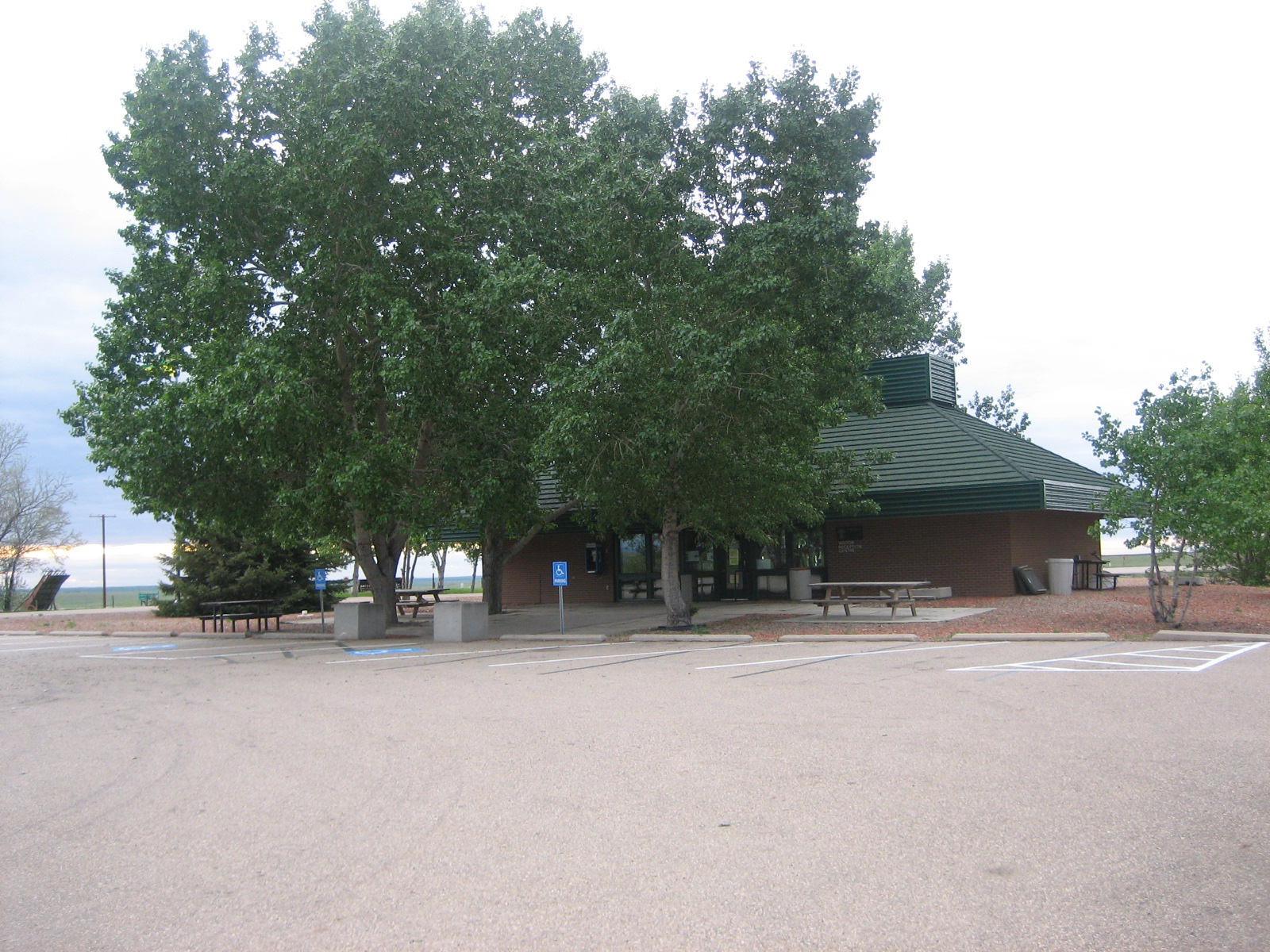
As we neared Calgary, a thunderstorm erupted and the wind picked up. Not good when you are towing a trailer. The wind was sideways and started ripping up the tarp covering the goods in the back of the truck. I would pull at a stop once in a while to tighten the crappy tie-down straps over the crappy tarps I had purchased at CT before the trip. It did nothing. At some point, I tightened the strap so much that the cheap alloy mechanism broke. We kept pushing ahead. We made it across Calgary, stopping along the way to Medicine Hat and into Saskatchewan. The weather was getting worse. The wind was raging at around 90kph, still sideways at that. We stopped in Maple Creek for the night. We had wasted over half a day and it was getting dark. If I remember correctly, there was an official rest stop, but the visitor centre was closed. We didn’t care. We wanted to rest, but we kept on freezing instead. I finally drifted to sleep only to wake up soon after because some moron parked perpendicular to my truck and left his headlights on with his engine running. There was another car traveling with him and it too had its engine running. This time I was in the cab and my wife was in the trailer trying to keep her and the “boy” warm.

My teeth were chattering I was so cold, even after I started the truck and cranked up the heat. I called my wife on her cell. I didn’t want to get out

Tarp after Moose Jaw

Tarp after Moose Jaw

of the truck. She wasn’t sleeping because of the cold. I asked her if she could get back in the truck, so we could keep on driving. We got back on the highway. The wind and snow were still raging. I pulled into a side road to tighten the tie downs and ropes and bungee cords for the umpteen time. Nothing doing. Curiously, there was a parked car with Ontario license plates. It looked like it had been abandoned there for a while. We stopped in Swift Current for gas and purchased a few more bungee cords. They were useless as the wind was too strong.

When we reached Moose Jaw, SK I saw a Canadian Tire sign and decided to stop to purchase a good tarp to put over the crappy ones that had been shredded by now. I bought a few more bungee cords for good measure. In the pouring rain, I set about to install the tarp and to tie it up. This time it held and would hold for the rest of the trip.

Java Man in Brandon

Java Man in Brandon

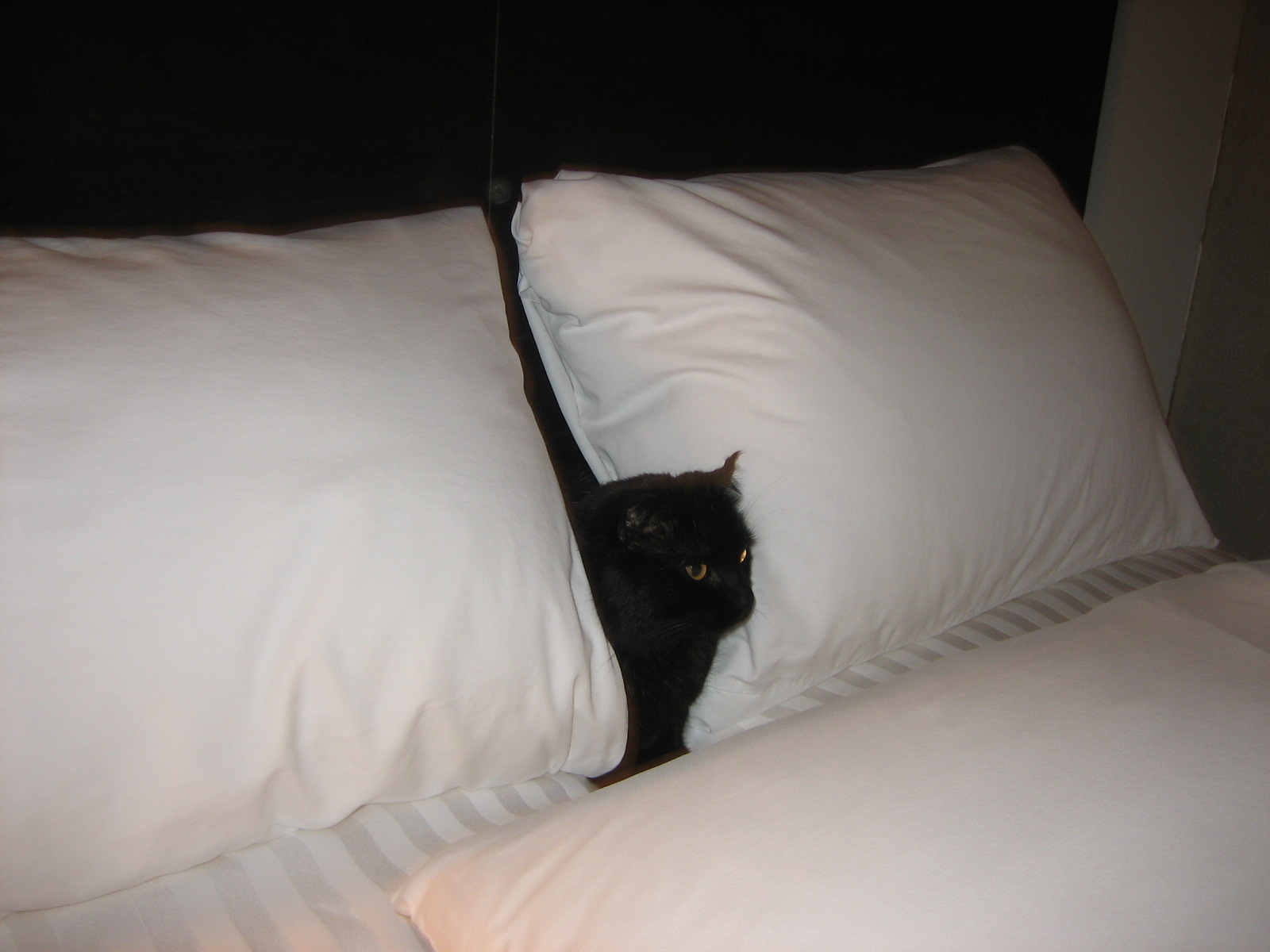
I was soaking wet. We made it past Regina and stopped in Indian Head at a gas station and diner. The road was bad. Tired and still wet, we made it to Brandon, Manitoba where we stopped at the Days Inn for the night. There was no way we could spend another night in the truck or trailer. I sneaked in Java Man. He wasn’t happy one bit with the travel arrangements. At least we all warmed up and had some rest. It turns out that they allowed pets.

The next morning, the sun showed its face and we were on our way to Ontario. Before we made it to the border, we had to get past Winnipeg. We wanted to circumvent the city at any cost and took the by-pass. Besides construction work going on, the road was in very bad condition and the load in the trailer shifted quite a bit.  Little did we know that it was a sign of things to come?

Posted in The Driver's Edge | Tagged , , , , , , , , , , , , , , | Leave a comment

Eurokracy. What is it?

So last weekend was the fourth edition of Eurokracy Montreal, at the home of the Bombardier CSeries, Mirabel. What is it? To be brief, it is basically a huge car festival, where people meet-up, talk about European cars, show off their creations, and race them on the Mirabel track. Supposedly, it is one of the biggest car events in Canada, and having finally seen it with my own eyes, I can believe that. You just can’t be left ambivalent to how impressive the whole show is. If you like cars, you will have a good time, even if the mood is very “Fast and Furious”.

Moreover, the overall feeling is one of inclusion; hardcore racers share words and admiration with tuners, stancers, classic car restorers and enthusiasts alike. It is really fun, and is probably one of the best car shows I’ve enjoyed. I mean, where else can you find a Rats Golf, a Renault 21 Turbo, a Classic Beetle, a modified Mercedes 500E, a Nissan Silvia, a Liberty Walk Nissan GTR, a modified Mk2 Golf and a Land Rover? But as they say, a picture is worth a 1000 words. So here are a few millions worth of words:


Cool, innit? I’ll definitely be going back!


Posted in Philosophy of driving | Tagged , , , , , , , , , , , , , , , , , , , , , , , , , , , , , , , , , , , , , , , , | Leave a comment